• Skip to primary navigation
  • Skip to main content

Royal Hospital for Children and Young People

  • Home
    • Children
      • Coming to hospital
      • Being in hospital
      • Tests, Scans & X-rays
      • Having an operation
      • Going home
      • Wellbeing Hub
      • Health Resources
    • Young People
      • Coming to a clinic
      • Staying on a ward
      • Tests, Scans & X-rays
      • Going home
      • Transition to adult services
      • Wellbeing Hub
      • Health Resources
    • Parents and Carers
      • Accommodation for families
      • Financial Help & Advice
      • Charity support for children & families
      • Spiritual Care & The Sanctuary
      • Child Protection
      • Social Work
      • Play Service
      • Children with learning disabilities
      • Support and further information
      • Health Resources
  • Departments & Services
    • Community Services
    • Departments & Services
    • Health Resources
  • The RHCYP
    • Travel & Transport
    • Patient & Visitor Facilities
    • Wellbeing & further support
    • Radio Lollipop
    • Health Resources
  • Get Involved
    • About Us
    • ECH Charity
    • Family Council
    • Volunteer
    • Scottish Hospitals Inquiry
    • Radio Lollipop
  • Emergency Department
  • Show Search
  • Facebook
  • Twitter
Generic selectors
Exact matches only
Search in title
Search in content
Post Type Selectors
Search in posts
Search in pages
Filter by Categories
Accident and Emergency
Acorn Suite
Air Ambulance
Allergy
Anaesthetic
Asthma
Audiology
Bereavement Service
Blood Tests
Borthwick Ward
Brain
Breathing
Breathing support & Ventilation
CAMHS
Cardiology
Care Experienced Medical Team
Castle Mey Ward
Child Life & Health
Child Protection
Clinical Genetics
Clinical Research
Community Paediatrics
Community Services
Crichton Unit
Critical Care
Crohns
Cystic Fibrosis
Dalhousie Ward
Dental Service
Departments
Diabetes
Dietetics
Dirleton Ward
Discharge Planning Service
Dunvegan Ward
Ear Reconstruction
Emergency Department
Endocrinology
Epilepsy
Epilepsy Surgery
Gastroenterology (GI)
General Paediatrics
Haematology
Hepatology (Liver)
Hormones
IBD
Imaging Department (Scans & X-Rays)
Immunology and Infectious Diseases
Inflammatory Bowel Disease
Little France School
Lochranza
Major Trauma
Melville Unit
Neurodiversity
Neurosciences
Occupational Therapy
Oncology
Ophthalmology
Orthopaedics
Outpatients
Palliative Care
Pharmacy
Phlebotomy
Physiotherapy
Planned Investigations Unit
Plastic Dressings Clinic
Play
PPALS
Respiratory Department
Resuscitation Videos
Resuscitation Videos - British Sign Language (BSL)
Resuscitation Videos – Arabic
Resuscitation Videos – Bengali
Resuscitation Videos – Bulgarian
Resuscitation Videos – Cantonese
Resuscitation videos – English
Resuscitation Videos – Mandarin
Resuscitation Videos – Polish
Resuscitation Videos – Romanian
Resuscitation Videos – Spanish
Resuscitation Videos – Urdu
Rheumatology
Scans & X-Rays
Sleep
Social Work
Speech and Language Therapy
Spiritual Care
St John’s Hospital
Surgery
Trauma Service
Vision and Development
Hide Search

Parents and carers

Limp in the absence of injury and irritable hip

· Oct 17, 2024 ·

Your child has presented to the Emergency Department with a limp or hip/knee pain without a preceding accident or injury.

This is a common reason for children to attend and the most likely cause is a condition called “transient synovitis” or “irritable hip.” It can cause similar symptoms in a knee but the hip is more common.

There are other causes of these symptoms which your nurse practitioners or doctor will consider and investigate if required.

The following information is from the NHS website.

What causes an irritable hip?

The condition develops when the lining that covers the hip joint (the synovial membrane) becomes irritated and inflamed, although the cause of inflammation is unclear.

Some cases of irritable hip occur following a viral infection in the chest, throat or digestive system. Many experts think the synovial membrane in the hip becomes inflamed as a complication of the infection. However, there is no hard evidence to support this theory.

Another theory is that a hip injury may cause the swelling, although many cases develop in children who do not have a history of injury.

Who is affected?

Irritable hip can affect boys and girls of any age, but is most common between the ages of 4 and 10 years. The condition affects twice as many boys than girls.

Is it serious?

As a parent, it can be very worrying if your child is diagnosed with an irritable hip and is struggling to walk. However, the pain usually passes within two weeks and most cases don’t require specific treatment.

A small number of children with irritable hip go on to have further episodes. However, these episodes usually become less frequent and eventually stop when the child is older.

Recovery

Ibuprofen, a commonly available painkiller, can be used to relieve pain and reduce inflammation. Your child should also rest the affected leg until symptoms have passed. Massaging the affected hip and applying heat may also help to reduce your child’s hip pain.

It usually takes a couple of weeks to recover from an irritable hip, although your doctor may recommend that your child does not play sports or take part in any strenuous activities for at least another two weeks following treatment. This is to reduce the chances of irritable hip returning.

Local data suggests that there is a small probability (less than 10%) that your child’s limp is caused by a different condition. If this is the case your child may not improve in terms of pain and visible limping over the expected two weeks.

Please phone Emergency Department reception on 0131 312 0007 or 0131 312 0008 if your child still has pain or limp two weeks after you first visit the Emergency Dept.

Ask for an “ED Review Clinic Face to Face appointment”. These clinics are held on the Ground Floor of Outpatients at the main entrance to the children’s hospital.

You must return to the main Paediatric Emergency Department if:

  • Your child develops a fever and still has leg pain / limp
  • Your child appears unwell including vomiting, very pale, tired
  • Your child develops a worsening limp such that they cannot walk or put weight through that leg
  • Your child’s skin or joint(s) becomes red, swollen, hot or painful
  • Your child develops severe back or genital pain
  • You have significant concerns about them.

Please try to arrive in the morning (08:30 – 10:00) so there is time to arrange scans should they be required.
Pulled elbow

· Oct 17, 2024 ·

Your child has presented to the Emergency Department with a pulled elbow. This is a very common injury seen in our department, usually in children under school age.

What is it?

A pulled elbow occurs when one of the bones of the forearm (the radius) slides out of the ligament holding it in place at the elbow.

This injury occurs when the arm is pulled, as can happen when the child’s hand is being held and they try to pull away, or if the child is being swung by the arms in play. Sometimes a “click” can be heard at the time of the injury.

When this occurs, the child will naturally be distressed and will hold the arm by their side.

Treatment

Your child will be seen by a doctor or a nurse practitioner who will attempt to move the arm back into its normal position. Full movement of the arm should be restored. This can be confirmed by observing your child in the play area for a few minutes.

In some cases, the child may still be reluctant to move the arm afterwards, in which case a “collar and cuff” (type of sling) will be applied to give the arm support for 1-2 days, followed by a review at our clinic.

Recurrence

This condition can recur; however, it is much less common as children reach school age.

To reduce the chances of this happening again, try to avoid any movement that causes a pulling action on your child’s arm, such as those previously mentioned in this leaflet.

Bottom shuffling babies

· Oct 17, 2024 ·

Bottom-shuffling babies sit on their bottoms and move themselves around using their legs, and sometimes their arms to propel themselves, rather than crawling.

They may use a variety of techniques to do this; some lean to the side and use one arm and leg, some use both legs together and some bounce. Bottom-shuffling is often seen in babies who have not spent time playing on their tummy.

Most bottom shufflers are “late walkers” (typically anything from 18 – 24 months of age). Typically, they will often lift their legs up when you attempt to support them in standing.

Normal lower limb variants in childhood

· Oct 17, 2024 ·

Flat Feet – What are they?

Most adult flat feet have an arch along the inside edge of the foot, some higher than others. A foot is described as flat when this arch is absent or reduced in standing. All children have very flat feet when they first start walking.

As they grow and walk, the soft tissues along the bottom of their feet tighten and get stronger which gradually shapes the arches of the feet.

Children with flexible flat feet often do not begin to develop an arch until the age of 5 years or older, and the foot arch is not fully developed until around 10 years of age.

Some children never develop an arch and are never symptomatic.

When to seek help

If your child appears to be in pain or you feel their function is being affected.

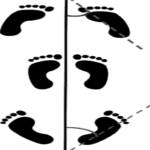
Intoeing and Outtoeing – What is it?

a black and white image of a foot print

A child is said to have an in-toeing gait when they walk with their feet turned inwards.

A child is said to have an out-toeing gait when their feet turn outwards when they walk.

Both patterns in most cases are completely normal as we all have different walking patterns.

For more information please refer to the APCP Intoeing gait leaflet.

Knock knees/Bow legs – What are they?

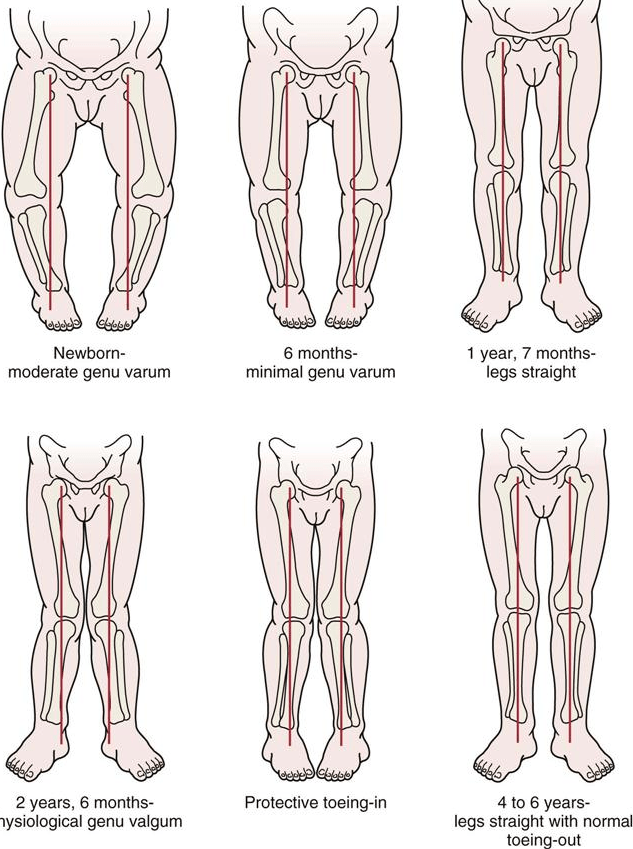
The diagram illustrates the progression of genu varum (bow legs) and genu valgum (knock knees) based on a child’s age:
At birth, newborns typically exhibit moderate genu varum (bow legs).
By 6 months, the bowing decreases and becomes minimal.
By the age of 1 year and 7 months, the legs usually straighten, showing no bowing.
At the bottom of the diagram, it shows the progression of genu valgum (knock knees) in three stages:
At around 2 years and 6 months, children develop physiological genu valgum (knock knees), often accompanied by protective toeing-in.
Between the ages of 4 to 6 years, the legs straighten naturally, with a normal toeing-out.

As all children develop, their legs change shape and position. All infants have some degree of bow legs which usually resolves by the age of 2.

By the age of 4, they begin to develop knock knees and this usually resolves to straight legs by the age of 8.

A slight degree of bowing or knocking is normal.

Bow Legs (or genu varum) – When a child stands with their feet together and there is a gap between their knees. This is particularly noticeable when a child starts walking but resolves spontaneously with normal child development.

Knock Knees (or genu valgum) – When a child stands with their knees together and there is a gap between their feet. Knock knees usually resolve spontaneously although a mild degree of genu valgum is normal and sometimes persists into adulthood.

Treatment Splints, insoles and exercises do not have any effect on knock knees or bow legs. It will resolve with normal development.

When to seek help

If your child has one leg that is significantly worse than the other, severe or worsening deformity or a history of trauma or infection.

Childhood growing pains

· Oct 17, 2024 ·

What are growing pains?

Growing pains are a common cause of recurring discomfort in children. They are aches, usually felt in the legs.

The pains usually occur in the evening or night. The pain can sometimes be bad enough to wake up your child in the night.

Usually growing pains occur in the legs, particularly

  • In the back of the leg below the knee (the calf)
  • At the front of the leg below the knee (the shin)
  • Around the ankles
  • At the front of the leg above the knee (the thigh)

Growing pains are usually felt in both legs but sometimes one more than the other, they are often felt in the areas between the joints, rather than in the joints themselves. They are not serious and settle in time of their own accord.

What causes growing pains?

It is not known what causes growing pains. They are not always caused by growing so ‘growing pains’ can sometimes be a confusing term. Various theories about the cause have been tested in studies but none have been proven.

Growing pains are sometimes more common in active children. It is possible that the pains are due to the effect of lots of activity on muscles and bones but do not cause damage so you do not have to restrict your child’s activity levels.

It is important to remember that growing pains do not develop into anything serious and do not do the child any harm.

Some research studies have suggested that growing pains might have a connection to vitamin D levels – especially living in Scotland multivitamins or vitamin D supplements sometimes seem to help with growing pains.

Who gets growing pains?

Growing pains usually affect children between the ages of 3 and 12 years. Up to half of all children may experience growing pains at some point.

What are the signs of growing pains?

There are no signs. If there is anything unusual to see in the area of the pain the cause is probably not growing pains and you should contact your GP.

Are any tests needed?

Usually, no tests are needed for growing pains. A doctor or physiotherapist can usually diagnose growing pains from your description and a physical examination. There should be nothing unusual to find on examination of a child with growing pains.

Blood tests and x-rays would be normal in a child with growing pains so there is no need to do these tests unless there are symptoms or signs suggesting other causes.

What treatment is there for growing pains?

Reassurance, gentle massage to the area and a hot water bottle or a warm bath can help with the pain and is usually all that is needed. In time growing pains should settle of their own accord, this however can take months and sometimes years.

Sometimes the pain can come and go during this time before completely settling.

Occasionally simple pain relief can help but often isn’t needed. Try the following stretches to see if they help your child’s pain.

Stretches to help with child’s pain


Hamstring stretch

  • Lie on the floor with both legs bent.
  • Lift one leg off of the floor and bring the knee toward your chest.
  • Clasp your hands behind your thigh below your knee.
  • Straighten your leg and then pull it gently toward your head, until you feel a stretch.

If you have difficulty clasping your hands behind your leg, loop a towel around your thigh.

Hold for 30 seconds and repeat 2-3 times and repeat 2-3 times on each leg.


Stretch Quads prone self

  • Lie face down.
  • Reach back and grasp the ankle.
  • Relax your leg and gently pull your ankle towards your buttocks.

Hold for 30 seconds and repeat 2-3 times and repeat 2-3 times on each leg.

Knee to Chest

  • Lie on your back on the floor with your legs extended straight out.
  • Bend one knee and hold below your knee with your hands.
  • Gently pull your knee toward your chest as far as it will go.

Hold for 30 seconds and repeat 2-3 times and repeat 2-3 times on each leg.

Wall push-ups or stretches for Achilles Tendon

  • Stand to face a wall with one leg forward with a slight bend at the knee.
  • Keep the leg behind you straight with the heel flat on the ground.
  • With both heels flat on the floor, press your hips forward toward the wall.

Hold for 30 seconds and repeat 2-3 times and repeat 2-3 times on each leg.

When should I see a doctor about growing pains?

If your child develops a limp, has warm swollen joints, or has signs of stiffness in the morning and a temperature with their pains.

  • « Go to Previous Page
  • Page 1
  • Interim pages omitted …
  • Page 7
  • Page 8
  • Page 9
  • Page 10
  • Page 11
  • Go to Next Page »
NHS Lothian and EHCH logos
  • Facebook
  • Instagram
  • Twitter

More Information

  • About Us
  • Accessibility statement
  • Freedom of Information (FOI)
  • Disclaimer

Contact NHS Lothian

Main Switchboard: 0131 536 1000

  • About Us
Manage Cookie Consent
We use cookies to optimise our website and our service.
Functional Always active
The technical storage or access is strictly necessary for the legitimate purpose of enabling the use of a specific service explicitly requested by the subscriber or user, or for the sole purpose of carrying out the transmission of a communication over an electronic communications network.
Preferences
The technical storage or access is necessary for the legitimate purpose of storing preferences that are not requested by the subscriber or user.
Statistics
The technical storage or access that is used exclusively for statistical purposes. The technical storage or access that is used exclusively for anonymous statistical purposes. Without a subpoena, voluntary compliance on the part of your Internet Service Provider, or additional records from a third party, information stored or retrieved for this purpose alone cannot usually be used to identify you.
Marketing
The technical storage or access is required to create user profiles to send advertising, or to track the user on a website or across several websites for similar marketing purposes.
  • Manage options
  • Manage services
  • Manage {vendor_count} vendors
  • Read more about these purposes
Preferences
  • {title}
  • {title}
  • {title}