• Skip to primary navigation
  • Skip to main content

Royal Hospital for Children and Young People

  • Home
    • Children
      • Coming to hospital
      • Being in hospital
      • Tests, Scans & X-rays
      • Having an operation
      • Going home
      • Wellbeing Hub
      • Health Resources
    • Young People
      • Coming to a clinic
      • Staying on a ward
      • Tests, Scans & X-rays
      • Going home
      • Transition to adult services
      • Wellbeing Hub
      • Health Resources
    • Parents and Carers
      • Accommodation for families
      • Financial Help & Advice
      • Charity support for children & families
      • Spiritual Care & The Sanctuary
      • Child Protection
      • Social Work
      • Play Service
      • Children with learning disabilities
      • Support and further information
      • Health Resources
  • Departments & Services
    • Community Services
    • Departments & Services
    • Health Resources
  • The RHCYP
    • Travel & Transport
    • Patient & Visitor Facilities
    • Wellbeing & further support
    • Radio Lollipop
    • Health Resources
  • Get Involved
    • About Us
    • ECH Charity
    • Family Council
    • Volunteer
    • Scottish Hospitals Inquiry
    • Radio Lollipop
  • Emergency Department
  • Show Search
  • Facebook
  • Twitter
Generic selectors
Exact matches only
Search in title
Search in content
Post Type Selectors
Search in posts
Search in pages
Filter by Categories
Accident and Emergency
Acorn Suite
Air Ambulance
Allergy
Anaesthetic
Asthma
Audiology
Bereavement Service
Blood Tests
Borthwick Ward
Brain
Breathing
Breathing support & Ventilation
CAMHS
Cardiology
Care Experienced Medical Team
Castle Mey Ward
Child Life & Health
Child Protection
Clinical Genetics
Clinical Research
Community Paediatrics
Community Services
Crichton Unit
Critical Care
Crohns
Cystic Fibrosis
Dalhousie Ward
Dental Service
Departments
Diabetes
Dietetics
Dirleton Ward
Discharge Planning Service
Dunvegan Ward
Ear Reconstruction
Emergency Department
Endocrinology
Epilepsy
Epilepsy Surgery
Gastroenterology (GI)
General Paediatrics
Haematology
Hepatology (Liver)
Hormones
IBD
Imaging Department (Scans & X-Rays)
Immunology and Infectious Diseases
Inflammatory Bowel Disease
Little France School
Lochranza
Major Trauma
Melville Unit
Neurodiversity
Neurosciences
Occupational Therapy
Oncology
Ophthalmology
Orthopaedics
Outpatients
Palliative Care
Pharmacy
Phlebotomy
Physiotherapy
Planned Investigations Unit
Plastic Dressings Clinic
Play
PPALS
Respiratory Department
Resuscitation Videos
Resuscitation Videos - British Sign Language (BSL)
Resuscitation Videos – Arabic
Resuscitation Videos – Bengali
Resuscitation Videos – Bulgarian
Resuscitation Videos – Cantonese
Resuscitation videos – English
Resuscitation Videos – Mandarin
Resuscitation Videos – Polish
Resuscitation Videos – Romanian
Resuscitation Videos – Spanish
Resuscitation Videos – Urdu
Rheumatology
Scans & X-Rays
Sleep
Social Work
Speech and Language Therapy
Spiritual Care
St John’s Hospital
Surgery
Trauma Service
Vision and Development
Hide Search

Parents and carers

Burns and scalds

· Oct 17, 2024 ·

What is a burn?

A burn is a type of injury to the skin or other tissues caused by heat, cold, electricity, chemicals, friction or radiation. Burns are one of the most common household injuries, especially among children.

Wound dressing

Your child may have a dressing applied in Accident & Emergency (A&E). It is important that this is kept clean and dry and ensure that your child avoids playing in sand or water. You should attend A&E if:

  • The dressing becomes wet, dirty or loose
  • There is an offensive smell from the dressing
  • There is leakage through to the outer layer of the bandage
  • There is increased pain from the wound
  • The bandage appears too tight and the fingers/toes become swollen, cold or blue.

Some of these could mean there is a wound infection, if left untreated this could delay healing.

Toxic Shock Syndrome

If a wound becomes infected, it can affect the whole body, causing a serious illness called Toxic Shock Syndrome. This is not a common illness; however, it is important that you recognise it. The signs and symptoms are as follows:

  • Fever (37.5˚c and above)
  • Rash – anywhere on the body
  • Vomiting
  • Diarrhoea
  • Lethargy.

If your child shows any of these symptoms, you should attend the Accident and Emergency department urgently.

Pain management

Your child may complain of pain for at least 48 hours after the injury occurred. Children’s paracetamol and ibuprofen can be given following the dosing instructions on the packaging, if you are unsure, please contact your GP or pharmacist for further advice.

Nutrition

It is important that your child continues to have a balanced diet including protein (e.g. yoghurts, chicken, eggs, milk, and beans) for good wound healing.

Depth of burn

There are 4 levels of burns; your child may have one or a mixture of these. The depths are as follows;

  • Superficial – heal within 7 days with no scarring.
  • Superficial Partial Thickness – heal within 10-14 days with little or no scarring.
  • Deep Partial Thickness/Deep Dermal – will leave a scar and may require a skin graft to heal.
  • Full thickness – will require a skin graft and will leave a scar.

Follow up appointments

You may be asked to arrange a practice nurse appointment at your GP or to attend an appointment in the Plastic Dressings Clinic in the outpatient department of the hospital (OPD 12, 1st floor by therapies) for further review.

This appointment should be within 48-72 hours following the burn/scald.

If you have been asked to return for an appointment, we request that you give your child some paracetamol or ibuprofen at least 1 hour before the appointment to make them more comfortable when the dressing is removed and the wound reviewed.
Care of a child in a removable cast or wrist splint

· Oct 17, 2024 ·

Your child has had a removable cast or splint applied. This is to help the injured area heal and to protect it. It will also relieve pain.

Why a removable cast?

Breaks to the bone or significant soft tissue (muscle, tendon or ligament) injuries can be managed with either a removable (soft) cast or a wrist splint. Both are easily removed and re-applied if required.

During the first 48 hours

The arm should be kept in the cast/splint and may be elevated in a sling in the first 48 hours to reduce the risk of swelling. Paracetamol and/or ibuprofen can be taken as required.

Your child should be encouraged to keep moving the fingers to prevent stiffness and help with swelling.

If further swelling occurs

You can loosen the cast/splint or remove it to relieve pressure. Once removed place the arm back in the sling or elevate it on a pillow. This will encourage the swelling to go down.

If the swelling doesn’t go down within a couple of hours or there is numbness or increased pain contact the Emergency Department on 0131 312 0007 or 0131 312 0008.

After the first 48 hours

The cast/splint can be removed 3 times a day for ten minutes to allow the skin to breathe.

It is recommended to keep the cast or splint on all the time at school, as it alerts people to the fact that you have an injury, it also protects the sore bit from any knocks in the playground.

It is recommended to wear the cast or splint for 7-10 days in total.

Follow up

After 10 days if your child is still having lots of pain, phone appointments at 0131 312 0007 (10 am – 10 pm) and book the next available Emergency clinic.

Broad arm sling

· Oct 17, 2024 ·

Why your child needs a broad arm sling

A broad arm sling is used to help support and protect injured shoulders, arms, wrists and hands after an injury. It can be worn over or under clothes.

How to apply the sling

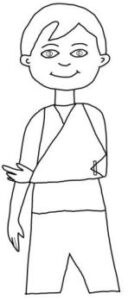
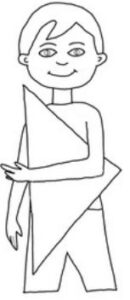
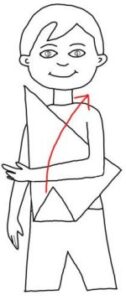
illustration of instructions in a paragraph below

Step 1

Place the injured arm across the body with the sling underneath. Position the point of the sling to the elbow.

Step 2

Fold the bottom corner up over the opposite shoulder and tie the ends of the sling comfortably behind the neck.

Step 3

Gather the loose material at the elbow and secure it with tape.

How to care for your child’s arm and sling

  • Keep the sling clean and dry.
  • Remove the sling at night as it is not safe to sleep in.
  • The arm can be placed on a pillow overnight to keep it raised.
  • When dressing, put clothes on the injured arm first, and take them out of clothes last.

Looking after a child in a cast

· Sep 26, 2024 ·

Your child has had a cast applied. This is to protect the injured limb and to relieve pain.

During the first 48 hours, the limb should be elevated as much as possible.

This is to help reduce the swelling which often occurs after an injury. It is important to encourage your child to move the fingers or toes of the affected limb as this helps to prevent them from becoming stiff and sore.

If you have further concerns including:

  • Increased pain
  • Numbness or “pins and needles” sensation in the fingers or toes
  • Swollen fingers or toes, with difficulty moving them
  • Blue appearance of fingers or toes
  • Cast becomes wet
  • Any foul odours from inside the cast
  • Condition of the cast
  • Any objects (coins etc) pushed inside the cast.

Please call for advice on 0131 312 0007 or 0131 312 0008 and ask to speak to the Orthopaedic Technician if available.

We may need to ask you to attend the hospital for a review of the injury or cast.

Pain

It is normal for there to be a degree of discomfort after an injury, however this should not be severe. The recommended dose of your child’s usual painkiller e.g. Paracetamol (Calpol) or Ibuprofen may be given. If the medication does not ease the pain, please call for advice.

Removing a soft cast

You should have received advice on how long to leave the cast on for. At the end of this time, you can remove the cast at home by unwrapping the bandage.

Follow-up

Most injuries heal very well and do not need any planned follow-up. We do like to review some injuries at either an Emergency Department clinic or a fracture clinic and you may be given an appointment for this before you leave.

Looking after a child with a fractured proximal humerus

· Sep 26, 2024 ·

What is the treatment?

Most patients with this type of fracture do not require surgery; the break can normally be managed without surgery.

The best way to treat the initial pain and discomfort is to place the injured arm in a ‘collar and cuff’ foam sling that allows the bruising and bone time to heal. The collar and cuff should be worn during the day for 2 to 3 weeks. Your child may find sleeping upright in a chair or with extra pillows more comfortable for the first few weeks.

Swelling and bruising at the fracture site are normal. There may also be a bump at the fracture site, but as the bone heals, this will become non-tender and settle.

Simple analgesia such as paracetamol and/or ibuprofen should be given regularly over the first few days and then as required for pain.

Hygiene and clothing

Your child will find it easier to get dressed by putting their injured arm into the sling first, and then putting it over the head. To remove clothing, simply reverse: the good arm out first and then the injured arm.

You can take the sling off to wash/shower as pain allows.

Your child should:

  • Keep their elbow, wrists and fingers moving to prevent stiffness.
  • Use their hand to feed themselves and wash their face as the pain allows.
  • Use the collar and cuff to hold their arm in a comfortable position.

The collar & cuff should be removed after 3 weeks. The shoulder may be a little stiff due to being in the collar and cuff and may take a few days to settle down.

Please avoid rough play and contact sports for a further two weeks.

  • « Go to Previous Page
  • Page 1
  • Interim pages omitted …
  • Page 8
  • Page 9
  • Page 10
  • Page 11
  • Go to Next Page »
NHS Lothian and EHCH logos
  • Facebook
  • Instagram
  • Twitter

More Information

  • About Us
  • Accessibility statement
  • Freedom of Information (FOI)
  • Disclaimer

Contact NHS Lothian

Main Switchboard: 0131 536 1000

  • About Us
Manage Cookie Consent
We use cookies to optimise our website and our service.
Functional Always active
The technical storage or access is strictly necessary for the legitimate purpose of enabling the use of a specific service explicitly requested by the subscriber or user, or for the sole purpose of carrying out the transmission of a communication over an electronic communications network.
Preferences
The technical storage or access is necessary for the legitimate purpose of storing preferences that are not requested by the subscriber or user.
Statistics
The technical storage or access that is used exclusively for statistical purposes. The technical storage or access that is used exclusively for anonymous statistical purposes. Without a subpoena, voluntary compliance on the part of your Internet Service Provider, or additional records from a third party, information stored or retrieved for this purpose alone cannot usually be used to identify you.
Marketing
The technical storage or access is required to create user profiles to send advertising, or to track the user on a website or across several websites for similar marketing purposes.
  • Manage options
  • Manage services
  • Manage {vendor_count} vendors
  • Read more about these purposes
Preferences
  • {title}
  • {title}
  • {title}