• Skip to primary navigation
  • Skip to main content

Royal Hospital for Children and Young People

  • Home
    • Children
      • Coming to hospital
      • Being in hospital
      • Tests, Scans & X-rays
      • Having an operation
      • Going home
      • Wellbeing Hub
      • Health Resources
    • Young People
      • Coming to a clinic
      • Staying on a ward
      • Tests, Scans & X-rays
      • Going home
      • Transition to adult services
      • Wellbeing Hub
      • Health Resources
    • Parents and Carers
      • Accommodation for families
      • Financial Help & Advice
      • Charity support for children & families
      • Spiritual Care & The Sanctuary
      • Child Protection
      • Social Work
      • Play Service
      • Children with learning disabilities
      • Support and further information
      • Health Resources
  • Departments & Services
    • Community Services
    • Departments & Services
    • Health Resources
  • The RHCYP
    • Travel & Transport
    • Patient & Visitor Facilities
    • Wellbeing & further support
    • Radio Lollipop
    • Health Resources
  • Get Involved
    • About Us
    • ECH Charity
    • Family Council
    • Volunteer
    • Scottish Hospitals Inquiry
    • Radio Lollipop
  • Emergency Department
  • Show Search
  • Facebook
  • Twitter
Generic selectors
Exact matches only
Search in title
Search in content
Post Type Selectors
Search in posts
Search in pages
Filter by Categories
Accident and Emergency
Acorn Suite
Air Ambulance
Allergy
Anaesthetic
Asthma
Audiology
Bereavement Service
Blood Tests
Borthwick Ward
Brain
Breathing
Breathing support & Ventilation
CAMHS
Cardiology
Care Experienced Medical Team
Castle Mey Ward
Child Life & Health
Child Protection
Clinical Genetics
Clinical Research
Community Paediatrics
Community Services
Crichton Unit
Critical Care
Crohns
Cystic Fibrosis
Dalhousie Ward
Dental Service
Departments
Diabetes
Dietetics
Dirleton Ward
Discharge Planning Service
Dunvegan Ward
Ear Reconstruction
Emergency Department
Endocrinology
Epilepsy
Epilepsy Surgery
Gastroenterology (GI)
General Paediatrics
Haematology
Hepatology (Liver)
Hormones
IBD
Imaging Department (Scans & X-Rays)
Immunology and Infectious Diseases
Inflammatory Bowel Disease
Little France School
Lochranza
Major Trauma
Melville Unit
Neurodiversity
Neurosciences
Occupational Therapy
Oncology
Ophthalmology
Orthopaedics
Outpatients
Palliative Care
Pharmacy
Phlebotomy
Physiotherapy
Planned Investigations Unit
Plastic Dressings Clinic
Play
PPALS
Respiratory Department
Resuscitation Videos
Resuscitation Videos - British Sign Language (BSL)
Resuscitation Videos – Arabic
Resuscitation Videos – Bengali
Resuscitation Videos – Bulgarian
Resuscitation Videos – Cantonese
Resuscitation videos – English
Resuscitation Videos – Mandarin
Resuscitation Videos – Polish
Resuscitation Videos – Romanian
Resuscitation Videos – Spanish
Resuscitation Videos – Urdu
Rheumatology
Scans & X-Rays
Sleep
Social Work
Speech and Language Therapy
Spiritual Care
St John’s Hospital
Surgery
Trauma Service
Vision and Development
Hide Search

Parents and carers

Looking after a child with a wrist fracture

· Oct 17, 2024 ·

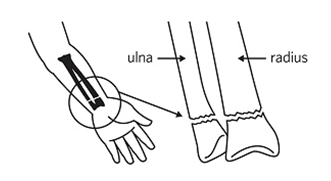
Diagram showing the bones of the forearm, labeled ulna and radius. In a wrist fracture, one or both of these bones may be broken

Wrist fractures are common injuries in childhood. There are two bones in the forearm – the radius and the ulna. In a wrist fracture, one or both of these bones may be broken.

Sometimes the bones may need to be put back into position by a doctor or nurse practitioner in the emergency department or operating theatre, or your child may need surgery.

Your child will need a cast to support and protect the bones while the fracture heals. It is important to care for your child’s wrist and cast correctly after you leave the hospital.

Treatment

Fractures are sore and pain is usually at its worst in the first few days. Your child will be much more comfortable when they are placed in the cast, but we would recommend regular painkillers such as paracetamol and/or ibuprofen over the first few days.

Wrist fractures can often swell, so it is very important to keep the arm raised. See arm elevation advice.

Encourage your child to gently keep their fingers moving and wriggling their and their elbow if the cast is below it.

Physiotherapy video

Follow-up

Most of these fractures heal well without any problems and we do not routinely follow them up. Occasionally we will organise a fracture clinic appointment for your child which will be given to you before you leave the Emergency Department.

You should have received advice on how long to leave the cast on for. Your child’s hand and wrist may be a bit stiff & sore when it is removed.

There may be some swelling where the fracture has been which is called callus and is a good sign that the fracture is healing.

If you have any ongoing concerns regarding your child’s wrist, please contact the Emergency Department on 0131 312 007 or 0131 312 008 and ask for a review clinic appointment.
Physiotherapy for lower limb fracture

· Oct 17, 2024 ·

What to expect after removing the cast

In order to help your fracture heal, the decision may be made to immobilise your leg or foot by placing it into a cast for a set period of time. This is typically around 4-6 weeks.

This will be decided by your orthopaedic doctor. After your cast is removed, you will probably have dry flaky skin, altered sensation, joint stiffness, muscle weakness and some swelling.

This leaflet will provide advice and exercises to help with these effects.

Skin Care

After your cast is removed it is helpful to massage non-perfumed moisturiser over your leg.

This will help hydrate the dry skin while also providing a positive touch to an area that has not been touched or moved for a period of time.

This will help with dry skin and sensory concerns

Exercises

The following exercises will help reduce swelling and stiffness and increase your joint movement.

Carry out these exercises regularly and gradually work through them. The exercises get harder as you work through the leaflet so it may be a few weeks before you can manage them all.

Exercises may feel difficult at first but should not be painful. If an exercise is painful, you should stop and try again later.

© Physiotools

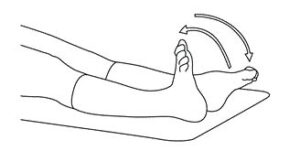
Exercise 1

Circle and paddle your ankles back and forth 10 times each as regularly as you can throughout the day.

This can be done while you are lying or sitting.

© Sarah Crombie

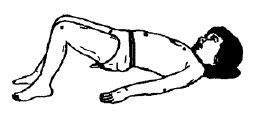
Exercise 2

  • Lie on your back and draw your feet under your knees.
  • Keep your knees hip-width apart.
  • Lift your hips up high.
  • Hold for 5 seconds at the top then slowly lower down.
  • Repeat 10 times
© Physiotools

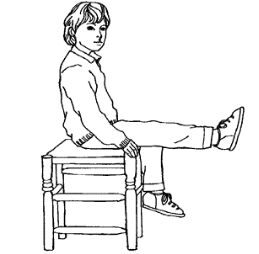
Exercise 3

  • While sitting in a chair point your toes up and kick your foot up to straighten your knee.
  • Hold for 3 seconds at the top.
  • Slowly lower back down.
  • Repeat 10 times.


© Physiotools

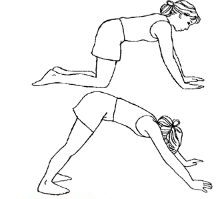
Exercise 4

  • Start on all fours.
  • Straighten your knees while trying to keep your heels on the ground.
  • Hold for 20 seconds.
  • Slowly lower down onto your knees.
  • Repeat 3 times.
© Physiotools

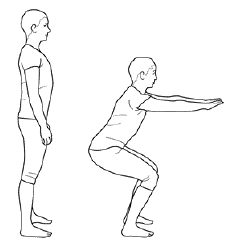
Exercise 5

  • Stand with your feet wider than your hips and with your toes pointing out slightly.
  • Bend your knees and push your hips back into a squat.
  • Keep your chest up.
  • Push back up into standing.
  • Repeat 10 times
© Physiotools

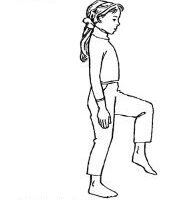
Exercise 6

  • Balance on one leg.
  • Aim to reach 30 seconds without wobbling.
  • If too tricky at the start, stand by a table for support.
  • If too easy, try throwing and catching a ball or passing it under your leg.

Activity Ideas

Your doctor will give you advice on returning to activity and sports. Here is a list of activities you can try to encourage to regain full function:

  • Short walks
  • Swimming
  • Cycling
  • Animal walks
  • Gardening
  • Squashing things with your foot

When to seek further help?

Your child may limp a little for many weeks after their cast is removed, especially in younger children and after increased activity.

If your child reports the following complaints after 3 – 4 weeks of following the advice in this leaflet please call the physiotherapy team to discuss further assessment:

  • Ongoing pain which stops your child from taking part in normal activities
  • Difficulty returning to normal function
  • Ongoing stiffness.

Call our self-referral number on 0131 312 1079 Monday-Friday between 08:30-16:30.

Care of a Child in a Scaphoid Removable Cast

· Oct 17, 2024 ·

Why a removable scaphoid cast?

Scaphoid fractures are often very difficult to see on the initial X-rays. They can’t always be confirmed until further examination or x-rays are taken at the review clinic.

The RC or splint will help support the injured part but is easily removed and can be used flexibly depending on how painful it is for your child.

During the first 48 hours

The arm should be kept in the RC/splint and may need to be elevated in a sling in the first 48 hours to reduce the risk of swelling. Paracetamol can be taken as this is when the injury is most likely to be painful.

Your child should be encouraged to exercise their fingers and hand by curling up the fingers into a fist and then stretching them out fully in repetitions of 5-10.

If further swelling occurs

You can loosen the RC/splint, or remove it to relieve pressure. Once the cast is removed, you should place the arm back in the sling. This will encourage the swelling to go down.

If the swelling doesn’t go down within a couple of hours or there is numbness or increased pain, you should contact the Emergency Department plaster room on 0131 312 0027.

After the first 48 hours

The RC/splint can be removed three times a day for ten minutes to allow the skin to breathe and also to apply cream to relieve any itching.

It is recommended to keep it on all the time at school, as it alerts people to the fact that your child has had an injury. It also protects the wrist from any knocks in the playground.

The above are guidelines. If the wrist is painful out of the RC/splint then put it back on.

If at any time, the thumb becomes pain-free out of the RC/splint contact the plaster room team between 9 am and 7 pm any day for advice on 0131 312 0027.

Physiotherapy video

Follow-up

You will be given an appointment card before you leave. Please make sure you hand it in to reception on your way out and the receptionist will give you a date and time to return to our clinic in about 2 weeks.

If you are unable to attend for any reason, please contact reception for an alternative appointment.

Appointments: 0131 312 1547

Plaster room: 0131 312 0027

Nurse: 0131 312 0018

Overuse injuries and effective return to sport

· Oct 17, 2024 ·

What causes an overuse injury?

An overuse injury is damage to a bone, ligament or tendon caused by stress from a repetitive movement, such as running. Although these types of injuries are common in athletic children and young people, they can be managed or completely avoided by promoting efficient recovery and managing the amount of physical activity they participate in each week.

What factors can contribute to an injury or slow down recovery?

Young people can get injured for lots of reasons. Your physiotherapist will discuss with you how you were injured, and what other factors might have contributed to you getting injured. Please see below for some of the main influences on injury occurrence.

Risk factors

  • Growth spurts
  • Training errors
  • Too little recovery time
  • Lack of sleep
  • Overtraining
  • Low levels of vitamin D
  • Low energy intake
  • Lack of strength
  • Stress

How can you promote efficient recovery?

Parents and carers

  • Encourage your child or young person to eat a balanced diet which includes fruits, vegetables and protein. This includes at least 8 cups of water a day
  • Ensure your child gets at least 8 hours of sleep a night.
  • Consider vitamin D tablets to supplement for Scottish winters
  • Manage the total amount of physical activity your child or young person is participating in each week.

Coaches

  • Encourage regular stretching during training sessions (some examples are shown below)- particularly during a young person’s growth spurt
  • Add some full-body strengthening exercises into training (e.g. squats, lunges and push-ups)
  • Ensure that children and young people are given enough time to recover after an intense training session or game.

Stretches


Hamstring stretch

  • Lie on the floor with both legs bent.
  • Lift one leg off of the floor and bring the knee toward your chest.
  • Clasp your hands behind your thigh below your knee.
  • Straighten your leg and then pull it gently toward your head, until you feel a stretch.

If you have difficulty clasping your hands behind your leg, loop a towel around your thigh.

Hold for 30 seconds and repeat 2-3 times and repeat 2-3 times on each leg.


Stretch Quads prone self

  • Lie face down.
  • Reach back and grasp the ankle.
  • Relax your leg and gently pull your ankle towards your buttocks.

Hold for 30 seconds and repeat 2-3 times and repeat 2-3 times on each leg.


Knee to Chest

  • Lie on your back on the floor with your legs extended straight out.
  • Bend one knee and hold below your knee with your hands.
  • Gently pull your knee toward your chest as far as it will go.

Hold for 30 seconds and repeat 2-3 times and repeat 2-3 times on each leg.

Wall push-ups or stretches for Achilles Tendon

  • Stand to face a wall with one leg forward with a slight bend at the knee.
  • Keep the leg behind you straight with the heel flat on the ground.
  • With both heels flat on the floor, press your hips forward toward the wall.

Hold for 30 seconds and repeat 2-3 times and repeat 2-3 times on each leg.

Managing physical activity levels

Managing the amount of high-intensity exercise your child or young person participates in each week will allow their bodies to properly recover.

A useful guide is to limit high-intensity activity to no more than 4 sessions per week and try not to participate in high-intensity activities 2 days in a row.

Download a table for managing physical activity levels  (Word)

Download a table for managing physical activity levels  (PDF)

Return to sport journey

Getting back after injury may take some time, and might involve ups and downs. Your physiotherapist will discuss with you things you can work on throughout your rehabilitation.

The body often needs a break after an injury, and your injured part may be ‘grumpy’ or sensitive for a while. It is ok to rest. Your physiotherapist can give you ideas of how to stay active and strong whilst you cannot do your chosen sports.

Think about what is it you want to be able to do again (your goal) and let your physiotherapist know so we can help you get there.

Care of a Child in a Brunner Removable Cast

· Oct 17, 2024 ·

Why a Brunner Removable Cast?

Removable casts are tailor-made and applied by practitioners experienced in casting techniques. A Brunner RC is applied for fractures to the thumb and also for significant soft tissue injuries to the thumb.

The RC is easily removed and re-applied if required.

During the first 48 hours

The arm should be kept in the RC and elevated in a sling at all times during the first 48 hours to reduce the risk of swelling.

Paracetamol can be taken as advised by the doctor or emergency nurse practitioner as this is when the injury is likely to be most painful.

Your child should be encouraged to exercise their fingers and hand.

If further swelling occurs

You can loosen the RC, or remove it to relieve pressure. Once removed, place the arm back in the sling. This will encourage the swelling to go down.

If the swelling doesn’t go down within a couple of hours or there is numbness or increased pain, you should contact the accident and emergency department on 0131 312 0007.

After the first 48 hours

The RC can be removed three times a day for ten minutes to allow the skin to breathe and also to apply cream to relieve any itching.

It is recommended that your child keeps the RC on all the time at school, as it alerts people to the fact that they have had an injury and that they should be careful not to knock it, it also protects the thumb from any knocks in the playground.

The above are guidelines. If the thumb is painful out of the RC then put it back on. If at any time, the thumb becomes pain-free out of the RC contact the plaster room team between 9 am and 9 pm any day for advice on 0131 312 0027.

  • « Go to Previous Page
  • Page 1
  • Interim pages omitted …
  • Page 6
  • Page 7
  • Page 8
  • Page 9
  • Page 10
  • Page 11
  • Go to Next Page »
NHS Lothian and EHCH logos
  • Facebook
  • Instagram
  • Twitter

More Information

  • About Us
  • Accessibility statement
  • Freedom of Information (FOI)
  • Disclaimer

Contact NHS Lothian

Main Switchboard: 0131 536 1000

  • About Us
Manage Cookie Consent
We use cookies to optimise our website and our service.
Functional Always active
The technical storage or access is strictly necessary for the legitimate purpose of enabling the use of a specific service explicitly requested by the subscriber or user, or for the sole purpose of carrying out the transmission of a communication over an electronic communications network.
Preferences
The technical storage or access is necessary for the legitimate purpose of storing preferences that are not requested by the subscriber or user.
Statistics
The technical storage or access that is used exclusively for statistical purposes. The technical storage or access that is used exclusively for anonymous statistical purposes. Without a subpoena, voluntary compliance on the part of your Internet Service Provider, or additional records from a third party, information stored or retrieved for this purpose alone cannot usually be used to identify you.
Marketing
The technical storage or access is required to create user profiles to send advertising, or to track the user on a website or across several websites for similar marketing purposes.
  • Manage options
  • Manage services
  • Manage {vendor_count} vendors
  • Read more about these purposes
Preferences
  • {title}
  • {title}
  • {title}