• Skip to primary navigation
  • Skip to main content

Royal Hospital for Children and Young People

  • Home
    • Children
      • Coming to hospital
      • Being in hospital
      • Tests, Scans & X-rays
      • Having an operation
      • Going home
      • Wellbeing Hub
      • Health Resources
      • Deaf Children & Families Group
    • Young People
      • Coming to a clinic
      • Staying on a ward
      • Tests, Scans & X-rays
      • Going home
      • Transition to adult services
      • Wellbeing Hub
      • Health Resources
    • Parents and Carers
      • Accommodation for families
      • Financial Help & Advice
      • Charity support for children & families
      • Spiritual Care & The Sanctuary
      • Child Protection
      • Social Work
      • Play Service
      • Children with learning disabilities
      • Support and further information
      • Health Resources
      • Deaf Children & Families Group
  • Departments & Services
    • Community Services
    • Departments & Services
    • Health Resources
  • The RHCYP
    • Travel & Transport
    • Patient & Visitor Facilities
    • Wellbeing & further support
    • Radio Lollipop
    • Health Resources
  • Get Involved
    • About Us
    • ECH Charity
    • Family Council
    • Volunteer
    • Scottish Hospitals Inquiry
    • Radio Lollipop
  • BSL
  • Emergency Department
  • Show Search
  • Facebook
  • Twitter
Generic selectors
Exact matches only
Search in title
Search in content
Post Type Selectors
Search in posts
Search in pages
Filter by Categories
Accident and Emergency
Acorn Suite
Air Ambulance
Allergy
Anaesthetic
Asthma
Audiology
Bereavement Service
Blood Tests
Borthwick Ward
Brain
Breathing
Breathing support & Ventilation
CAMHS
Cardiology
Care Experienced Medical Team
Castle Mey Ward
Child Life & Health
Child Protection
Clinical Genetics
Clinical Research
Community Paediatrics
Community Services
Crichton Unit
Critical Care
Crohns
Cystic Fibrosis
Dalhousie Ward
Dental Service
Departments
Diabetes
Dietetics
Dirleton Ward
Discharge Planning Service
Dunvegan Ward
Ear Reconstruction
Emergency Department
Endocrinology
Epilepsy
Epilepsy Surgery
Gastroenterology (GI)
General Paediatrics
Haematology
Hepatology (Liver)
Hormones
IBD
Imaging Department (Scans & X-Rays)
Immunology and Infectious Diseases
Inflammatory Bowel Disease
Little France School
Lochranza
Major Trauma
Melville Unit
Neurodiversity
Neurosciences
Occupational Therapy
Oncology
Ophthalmology
Orthopaedics
Outpatients
Palliative Care
Pharmacy
Phlebotomy
Physiotherapy
Planned Investigations Unit
Plastic Dressings Clinic
Play
PPALS
Respiratory Department
Resuscitation Videos
Resuscitation Videos - British Sign Language (BSL)
Resuscitation Videos – Arabic
Resuscitation Videos – Bengali
Resuscitation Videos – Bulgarian
Resuscitation Videos – Cantonese
Resuscitation videos – English
Resuscitation Videos – Mandarin
Resuscitation Videos – Polish
Resuscitation Videos – Romanian
Resuscitation Videos – Spanish
Resuscitation Videos – Urdu
Rheumatology
Scans & X-Rays
Sleep
Social Work
Speech and Language Therapy
Spiritual Care
St John’s Hospital
Surgery
Trauma Service
Vision and Development
Hide Search
You are here:
Home » Health Resources » Bottom shuffling babies
Baby boy is sitting on floor with tongue out next to his mother. There are toys around him

Information for parents

Bottom shuffling babies

Bottom-shuffling babies sit on their bottoms and move themselves around using their legs, and sometimes their arms to propel themselves, rather than crawling.

They may use a variety of techniques to do this; some lean to the side and use one arm and leg, some use both legs together and some bounce. Bottom-shuffling is often seen in babies who have not spent time playing on their tummy.

Most bottom shufflers are “late walkers” (typically anything from 18 – 24 months of age). Typically, they will often lift their legs up when you attempt to support them in standing.

Is it normal for children to bottom shuffle?

Yes – some children will master their motor milestones early and others will be much later and some may miss out on developmental milestones all together – such as crawling. Some babies will learn to bottom shuffle instead – this is a normal variant.

The rate at which a child develops is affected by many factors including temperament, environment, genetics/family history and development opportunities for example – if they have spent a long time in hospital or have not had the opportunity to play on the floor.

Why do some babies' bottoms shuffle?

Babies who bottom shuffle typically do not tolerate being placed on their tummy and therefore do not develop the strength in their arms, neck and back muscles to enable them to push themselves up, move around on their tummy or crawl.

They often prefer to lie on their back or to be supported in a sitting position.

These babies often do not learn to roll from their back onto their side or their tummy or vice versa. This makes it very difficult for them to learn to sit themselves up from lying down.

In general, babies who bottom shuffle have joints that are more supple/flexible than average. This makes it more difficult for the child to stabilise their joints to take weight through their arms and legs, making it harder for them to crawl and to stand and walk.

Babies who bottom shuffle can move very quickly and their hands are free to play with toys and can hold them whilst moving etc. They therefore often have little motivation to pull up to stand on their feet or use their arms to crawl.

How can I help my child?

illustration of three different types of tummy time. On the first one the baby is lying flat on their tummy. On the second one the baby is lying on their tummy on top of an adult who is lying flat on the floor. On the third one an adult is sitting with their legs stretched and the baby is lying across them

Tummy time

Encourage tummy time so that they can learn how to weight bear through their arms and their shoulder girdle to become more stable.

If they do not tolerate lying flat on the floor, give them some support under their chest using a rolled-up towel or lie them across your legs.

Sit on the sofa, lean back and lay your child on your chest (progress to lying on the floor with your child on your chest).

illustration of the child is shuffling over adults legs

Shuffling over obstacles

Encourage your child to shuffle over obstacles on the floor (such as over your legs/cushions, etc.) so that they have to bring their weight forward over their arms to move themselves forward.
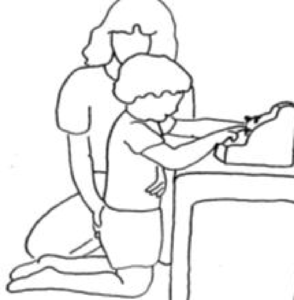
 

illustration of an adult support their child kneeling against a table

Help your child to kneel

Encourage your child to pull themselves up onto their knees, against you or a piece of furniture. Kneeling helps to improve stability around the hips and lower body.

Help your child to take weight through their legs
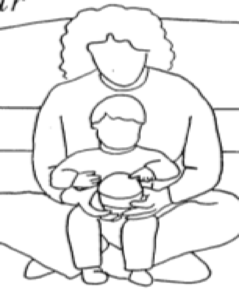
illustration of an adult sitting on the floor with their legs crossed. The child is sitting on top of adult's legs with the child's legs over adult's legs .The child has a ball on their knees

  • Sit on the floor with your legs crossed
  • Sit your child on your lap with their legs over yours and their knees bent so that their feet are flat on the floor.
  • If your child tends to lean backwards, use your body to keep their back straight and lean forwards slightly to stop them leaning back.

  • Encourage your child to lean forward to reach for toys/objects
  • Progress to reaching down to retrieve objects from the floor.

Help your child to pull to stand from your lap
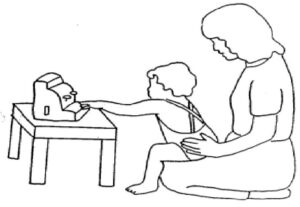
An adult is Kneeling on the floor in front of a coffee table. A child is sitting on adult's lap, with their hips and knees at 90 degrees and their feet are flat on the floor. The child is trying to reach a toy placed on the table

  • Kneel or sit cross-legged on the floor in front of a sofa or coffee table, etc.
  • Sit your child on your lap, making sure that their hips and knees are at 90 degrees and their feet are flat on the floor.
  • Place an interesting object/toy on the surface and encourage your child to reach forward for the object.
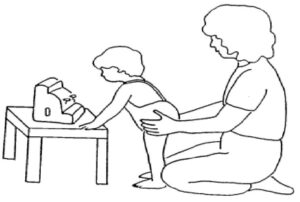
The child has straightened their knees and trying to reach a toy on a table while an adult is supporting them around their hips

  • As they straighten their knees, move their hips forwards and up, over their feet, supporting them around their hips with your hands.
  • Bottom shufflers tend to try to stand with their bottom behind their feet so they need help to bring their hips forwards, over their feet.
  • Encourage them to lean their tummy against the table/surface. When your child learns to stand up independently you no longer need to support them around their hips.
  • You can help your child learn to sit down by bringing their hips back and down onto your lap.

Will a “sit-in” baby walker or bouncer help my child to learn to stand and walk?

No – these do not help children develop their ability to stand or walk and may encourage your child to walk on their tip-toes. They have also been the cause of many serious accidents.

When to seek further advice/assessment from health professionals

  • If your child has difficulty moving their arms or legs (e.g. if they appear to be weak, floppy or stiff)
  • If your child appears to be using one side of their body more than the other. This may be the arm and/or leg (do they have a strong preference to turn their head to one side?)
  • If your child always falls to one side or backwards when they lose their balance
  • When your child stands, are they unable to bring one or both feet flat on the floor or is their foot position very different on both feet?
  • If your child shows significant delay in other areas of their development (e.g. play and language, fine motor skills)
  • If your child appears to be having problems with their vision or hearing.

If you are worried speak to your Health Visitor, general practitioner  (GP) or paediatrician.

Physiotherapy Team
Therapies Department,
Royal Hospital for Children and Young People,
50 Little France Crescent
Edinburgh
EH16 4SA

Get directions

Telephone: 0131 312 1079

View Physiotherapy department 

NHS Lothian and EHCH logos
  • Facebook
  • Instagram
  • Twitter

More Information

  • About Us
  • Accessibility statement
  • Freedom of Information (FOI)
  • Disclaimer

Contact NHS Lothian

Main Switchboard: 0131 536 1000

  • About Us
Manage Cookie Consent
We use cookies to optimise our website and our service.
Functional Always active
The technical storage or access is strictly necessary for the legitimate purpose of enabling the use of a specific service explicitly requested by the subscriber or user, or for the sole purpose of carrying out the transmission of a communication over an electronic communications network.
Preferences
The technical storage or access is necessary for the legitimate purpose of storing preferences that are not requested by the subscriber or user.
Statistics
The technical storage or access that is used exclusively for statistical purposes. The technical storage or access that is used exclusively for anonymous statistical purposes. Without a subpoena, voluntary compliance on the part of your Internet Service Provider, or additional records from a third party, information stored or retrieved for this purpose alone cannot usually be used to identify you.
Marketing
The technical storage or access is required to create user profiles to send advertising, or to track the user on a website or across several websites for similar marketing purposes.
  • Manage options
  • Manage services
  • Manage {vendor_count} vendors
  • Read more about these purposes
Preferences
  • {title}
  • {title}
  • {title}