What is it?
People who pop, click, or snap their hips during particular movements have snapping hip syndrome. Some people make an audible click when they bend at the hip.
For other people, they may feel a popping or catching in their hip joint.
There are two types of snapping hip and while they are mostly harmless, these conditions sometimes lead to joint pain.
Types of snapping hip

Internal snapping hip (at the front of the hip)
This type of snapping hip is the most common. It occurs when a tendon slides over bony structures at the front of the hip joint, creating tension and then releasing with a “snap.”
Tightness in the muscles around your bottom or hip is often the cause of the snapping sound.
People with internal snapping hip syndrome may experience:
- Hip popping is when: running, rising from a seated position or when the hip turns the leg away from the body.
- Pain that worsens with activity as repeated irritation is associated with inflammation of the structures at the front of the hip joint.

External snapping hip (at the side of the hip)
This occurs when a muscle or tendon slides over the top of the thigh bone. The resulting tension is followed by a release and snapping sensation at the outside of the hip. This is often due to tightness in the muscles around your bottom.
People with external snapping hip syndrome may experience:
- The snapping typically occurs during activities such as running and climbing stairs or carrying a heavy load like shopping or a heavy backpack.
- Hip popping can be accompanied by sharp, sudden pain felt on the outside of the hip.
- The hip can sometimes feel like it is about to pop out of its socket when snapping but it will not come out of its socket.
- Pain that worsens with activity, as repeated irritation causes the tendon to become inflamed.
Painful symptoms develop gradually; the pain may begin as a mild annoyance and worsen over weeks or months.
Treatment
- Rest: People with snapping hip syndrome are advised to avoid the motions or activities that cause the snapping, popping or clicking sensation as much as possible. Resting helps to reduce any irritation around the hip.
- Stretching: Often muscles surrounding the hip joint are tight and increasing their flexibility it can reduce pain and the amount of ‘snapping’ of the hip.
Daily stretching programme

Exercise 1
- Put one leg out behind you whilst half kneeling on the other.
- Keep your back straight and lean forward into your bent leg and feel the stretch over the front of your thigh on the leg behind.
- Hold for 30 seconds.
Repeat 3 times on both legs, daily.
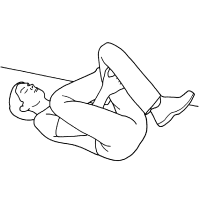
Exercise 2
- Lie on your back with your knees bent.
- Cross the ankle of the leg to be stretched over the other knee.
- Put your arms around your thigh.
- Bring your thigh towards your stomach. Feel the stretch in your bottom muscles.
- Hold for 30 seconds.
Repeat 3 times on both legs, daily.

Exercise 3
- Lie face down.
- Bend your knee and hold on to your ankle. Pull your heel towards your bottom. Feel the stretching on the front of your thigh.
- Hold for 30 seconds.
Repeat 3 times on both legs, daily.
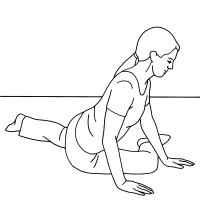
Exercise 4
- Sit on the floor.
- Bring one leg in front of you and bend your knee 45 degrees.
- Straighten your other leg behind you.
- Turn your body towards the bent leg and lean your body gently forward. Feel the stretch in your bottom muscles.
- Hold for 30 seconds.
Repeat 3 times on both legs, daily.
Physiotherapy video
Return to activity
Once your pain has improved or the ‘snapping’ sensation has reduced then you can gradually return to your usual activities. Ensure you warm up and cool down properly. Your pain should be used as a guide as to when to increase the length or amount of activity.
Further advice
If your symptoms are not settling, please contact the physiotherapy department on the details below:


