• Skip to primary navigation
  • Skip to main content

Royal Hospital for Children and Young People

  • Home
    • Children
      • Coming to hospital
      • Being in hospital
      • Tests, Scans & X-rays
      • Having an operation
      • Going home
      • Wellbeing Hub
      • Health Resources
    • Young People
      • Coming to a clinic
      • Staying on a ward
      • Tests, Scans & X-rays
      • Going home
      • Transition to adult services
      • Wellbeing Hub
      • Health Resources
    • Parents and Carers
      • Accommodation for families
      • Financial Help & Advice
      • Charity support for children & families
      • Spiritual Care & The Sanctuary
      • Child Protection
      • Social Work
      • Play Service
      • Children with learning disabilities
      • Support and further information
      • Health Resources
  • Departments & Services
    • Community Services
    • Departments & Services
    • Health Resources
  • The RHCYP
    • Travel & Transport
    • Patient & Visitor Facilities
    • Wellbeing & further support
    • Radio Lollipop
    • Health Resources
  • Get Involved
    • About Us
    • ECH Charity
    • Family Council
    • Volunteer
    • Scottish Hospitals Inquiry
    • Radio Lollipop
  • Emergency Department
  • Show Search
  • Facebook
  • Twitter
Generic selectors
Exact matches only
Search in title
Search in content
Post Type Selectors
Search in posts
Search in pages
Filter by Categories
Accident and Emergency
Acorn Suite
Air Ambulance
Allergy
Anaesthetic
Asthma
Audiology
Bereavement Service
Blood Tests
Borthwick Ward
Brain
Breathing
Breathing support & Ventilation
CAMHS
Cardiology
Care Experienced Medical Team
Castle Mey Ward
Child Life & Health
Child Protection
Clinical Genetics
Clinical Research
Community Paediatrics
Community Services
Crichton Unit
Critical Care
Crohns
Cystic Fibrosis
Dalhousie Ward
Dental Service
Departments
Diabetes
Dietetics
Dirleton Ward
Discharge Planning Service
Dunvegan Ward
Ear Reconstruction
Emergency Department
Endocrinology
Epilepsy
Epilepsy Surgery
Gastroenterology (GI)
General Paediatrics
Haematology
Hepatology (Liver)
Hormones
IBD
Imaging Department (Scans & X-Rays)
Immunology and Infectious Diseases
Inflammatory Bowel Disease
Little France School
Lochranza
Major Trauma
Melville Unit
Neurodiversity
Neurosciences
Occupational Therapy
Oncology
Ophthalmology
Orthopaedics
Outpatients
Palliative Care
Pharmacy
Phlebotomy
Physiotherapy
Planned Investigations Unit
Plastic Dressings Clinic
Play
PPALS
Respiratory Department
Resuscitation Videos
Resuscitation Videos - British Sign Language (BSL)
Resuscitation Videos – Arabic
Resuscitation Videos – Bengali
Resuscitation Videos – Bulgarian
Resuscitation Videos – Cantonese
Resuscitation videos – English
Resuscitation Videos – Mandarin
Resuscitation Videos – Polish
Resuscitation Videos – Romanian
Resuscitation Videos – Spanish
Resuscitation Videos – Urdu
Rheumatology
Scans & X-Rays
Sleep
Social Work
Speech and Language Therapy
Spiritual Care
St John’s Hospital
Surgery
Trauma Service
Vision and Development
Hide Search

Parents and carers

Foot and ankle moonboot

· Oct 21, 2024 ·

Your child has sustained an injury to their foot or ankle that is stable and can be managed in a moonboot. They will have been fitted with the appropriately sized boot in the Emergency Department and they should be able to walk comfortably with the boot on.

To put the boot on and off place it flat on the floor, undo the Velcro straps and place the foot into the walker. Close the lining first and then secure it with the Velcro straps. Make sure it is not too tight but also that the foot is not moving around inside the boot.

You should have received advice on how long to leave the moonboot on for. The boot can be removed for bathing or showering but they may have to sit on a stool in the shower. It can also be removed at nighttime and the leg can be elevated and supported on a pillow.

At the end of the recommended time using the boot if you have any concerns and would like your child to be reviewed again, please call 0131 312 0007 or 0131 312 0008 to arrange a follow-up appointment. You can also call this number for any questions about the boot.
Caring for your child in a hip spica plaster cast

· Oct 20, 2024 ·

Daily Checks

Check the skin at the edges of the cast for signs of:

  • Redness, broken skin or blisters
  • Cracking or damage to the plaster
  • Staining or soakage through the cast
  • Swollen or blue discolouration of the toes
  • Pain or sore areas
  • A nasty smell from under the cast
  • An unusually irritable child

If you are worried about any of the above, please contact the hospital.

Toileting

  • If toilet trained, use a bedpan or urinal and protect the cast with tissues. After passing urine/moving bowels, ensure all skin areas are clean and dry.
  • If not toilet trained, tuck a small nappy inside the cast; this nappy will need to be changed every 2-3 hours during the day, and one to two nappy changes during the night. A larger nappy will be worn around the cast to keep the internal nappy in place; this will be changed daily or if soiled.
  • It is helpful to leave the nappy area exposed for a short time daily to allow air to the cast and skin.

Washing and Hygiene

  • Wash and dry all showing skin as normal and apply a moisturising cream.
  • Do not use talc, sprays or creams under the cast.
  • Tuck a towel around the cast edges to keep it dry.
  • It is easiest to wash hair lying down.

Eating and Drinking

  • Position the child as they find comfortable.
  • Your child may eat less but more often because of the plaster.
  • A healthy diet including fresh fruit, vegetables, and plenty of drinks is important to avoid constipation.
  • Bendy straws make drinking easier.
  • Cover the top of the cast with a t-shirt/bib to avoid food going down the cast.

Clothing

  • Flexible clothing to cover nappies or pads can be worn.
  • Loose natural fibre clothing such as t-shirts, jogging bottoms, and elasticated skirts are best.
  • Alter pants by cutting the side seams and using Velcro.
  • Wear socks to stop their feet from getting cold.

Mobility/Seating

  • It is important that your child continues to move as advised by the doctor and physiotherapist.
  • Your child’s occupational therapist may see you in the hospital to advise you about seating.
  • The floor may be the safest place to play.
  • Use pillows, blankets or beanbags for support.
  • Change your child’s position every 1-2 hours, from back to tummy and sides, checking that the toes are not being squashed.
  • Do not lift your child under the arms without supporting the weight of the plaster, as the plaster may move.

Play

Your child may feel very bored and frustrated while in the cast. To avoid this, spend time playing games, drawing, watching TV, or doing schoolwork. Friends should be encouraged to visit.

Sleeping

You will need to change your child’s position every 2-3 hours during the night as they will become uncomfortable.

Other Important Points

Avoid poking any objects under the cast which could cause skin sores. Itches under the plaster can be a problem. Distraction with toys and games can help. If the itch is severe, discuss this with your doctor who may prescribe some medicine to help.

Further Information & Contact Telephone Numbers

We hope that this leaflet has been useful, but if you have any questions, please ask one of the staff. Once home, if you have any worries or questions about your child in the cast, please contact your:

  • General Practitioner
  • Community Nurse
  • Orthopaedic Cast Technician: Mon – Fri 9 am to 4 pm
    Telephone: 0131 536 1000
  • Ward that your child was in
  • Accident & Emergency Department
    Telephone: 0131 312 0007

Advice after using a Pavlik harness

· Oct 20, 2024 ·

What to expect after harness removal

  • Just like when the harness was applied, your baby may be unsettled for the first 48-72 hours after removal of the harness.
  • Your child may, when relaxed, still have their legs in the frog leg position, gradually this will improve.
  • The chest strap of the harness provided increased support to your baby when carrying, now it has been removed you may feel they are less sturdy and require more support
  • We continue to recommend no swaddling of the legs when the harness is removed and to keep the legs free.
  • Being in a harness reduces a baby’s ability to roll. Now it has been removed you may notice your baby is more inclined to move and therefore should not be left unsupervised on changing tables. Some babies however will not roll, and in isolation, this should not be cause for concern.
  • Being treated for hip dysplasia in a harness should not cause a delay in gross motor skills like crawling and walking once it has been removed.

Signs to look out for

Your baby’s hips have been examined normally on removal of the harness however we would like you to continue to monitor and contact us should you notice any of the following:

  • One leg cannot be moved out sideways as far as the other when changing your baby’s nappy
  • One leg seems to be longer than the other
  • One leg drags when your baby starts crawling
  • Your child walks with a limp or has a ‘waddling’ gait when they start walking, or they walk on tiptoes on one side.

What are the next steps?

Your child will be followed up at 1 year of age with a pelvic X-ray and clinical check to ensure normal ongoing development of the hips. It is not uncommon to require further reviews after this.

Further information

Following treatment for hip dysplasia, we do not recommend the use of baby walkers, baby bouncers or jumperoos and suggest allowing your baby to get up on their feet in their own time.

Contact Us

If you have any concerns and require more information, please contact your physiotherapist

Developmental dysplasia of the hip

· Oct 20, 2024 ·

What is the problem with my baby’s hip joints?

The hip joint is made up of a ball which sits into a socket. As a baby’s hip joint is made of cartilage (which is soft and malleable) the development can be affected and the socket part can be shallow.

This allows the ball part to slip in and out of the socket part. Although your baby is not in any discomfort, this could cause them difficulties as they grow if it is not dealt with at this stage.

The condition is called Developmental Dysplasia of the Hip (DDH).

What causes the hips to be shallow?

Sometimes there is a family history of hip dysplasia or there has been restricted movement of the baby during the pregnancy due to breech position or reduced fluid levels around the baby. Often there is no reason.

Perthes disease

· Oct 20, 2024 ·

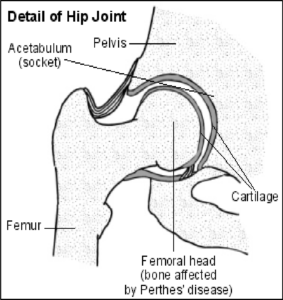
Detailed illustration of the hip joint showing key components including the acetabulum (hip socket), pelvis, femur (thigh bone), cartilage, and the femoral head. The femoral head is affected by Perthes disease

What is it?

It is a condition that affects the hip joint in children. The severity of this can vary and it is not clear why this problem occurs. It is not due to injury or to a general health condition as a child with Perthes disease is usually otherwise well.

Perthes is much more common in boys and occurs in both hips only about 10% of the time.

Perthes usually occur in children aged 4 to 10 years old.

What happens at the hip joint?

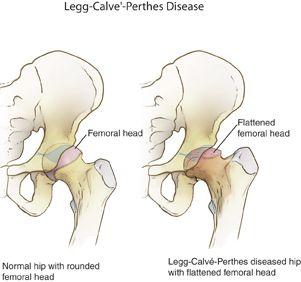
Illustration comparing a normal hip joint with a hip affected by Legg-Calvé-Perthes disease. The normal hip shows a smooth, round femoral head fitting perfectly into the acetabulum, while the hip with Perthes disease shows a flattened and irregular femoral head, indicating bone damage.

The blood supply to the hip is disrupted and doesn’t get to the ball section of the ball and socket joint which causes that part of the bone to soften. Typically the ball part of the hip joint takes on a flattened, rather than rounded, shape and eventually may fail to fit properly inside the hip socket.

Over several months the blood vessels re-grow, and the blood supply returns to the bone tissue. New bone tissue is then laid down and the bone re-grows and remodels over several years.

This is similar to how bone reforms and remodels after a break to a bone, but takes longer.

It can take between 2 and 5 years to re-grow.

What are the symptoms?

Symptoms tend to develop gradually and can include:

  • An occasional limp in the earlier stages. The limp may gradually become worse over a few weeks. However, it is often painless.
  • Pain in the hip and groin area. The pain may radiate to the knee or thigh. In some cases, pain in the knee is the first symptom. Pain occurs when putting weight on the affected leg or moving the hip joint.
  • Stiffness and reduced range of movement of the affected hip.
  • In time, the affected leg may become slightly thinner (wasted) as it is not used as much as the other leg.
  • Eventually, the affected leg may become shorter than the unaffected leg.

What is the treatment?

In most cases, the blood supply to the hip joint returns and the bone regenerates by itself. This can take anywhere between two and five years.

During this critical period, the bone is soft and vulnerable.

The aim of treatment is to protect the hip joint and promote the healing process whilst reducing joint pain and stiffness.

This ensures the ball part of the hip joint grows into a functional shape and ensures that it remains well seated in the hip socket as it heals and remodels.

Treatment depends on the age of the child and the severity of the condition, but may include:

  • Observation and conservative treatment: Some cases heal well without any treatment, particularly children aged five and under, and milder cases. So, in some cases, the Orthopaedic doctor may simply review your child every now and then to check that the hip joint remains in the right place as it heals.
  • Crutches may be needed for a period of time to alleviate the pressure on the hip joint whilst the bone is soft.
  • Avoidance of high-impact activities such as running or jumping.
  • A home exercise programme to improve hip movement.
  • Surgery is very occasionally required to protect the hip joint.

Who will be involved with my child?

An Orthopaedic doctor will review your child regularly as well as a Physiotherapist who will give you exercises and monitor the movement in your child’s hip.

Your child requires regular x-rays to monitor the progress of the condition but this may not happen with every consultation.

What is the outcome?

In most cases, children recover from Perthes disease as the hip joint returns to normal in its shape and function. It can take two or more years for this to occur after the condition first develops.

If you have any concerns, contact:

  • « Go to Previous Page
  • Page 1
  • Interim pages omitted …
  • Page 4
  • Page 5
  • Page 6
  • Page 7
  • Page 8
  • Interim pages omitted …
  • Page 11
  • Go to Next Page »
NHS Lothian and EHCH logos
  • Facebook
  • Instagram
  • Twitter

More Information

  • About Us
  • Accessibility statement
  • Freedom of Information (FOI)
  • Disclaimer

Contact NHS Lothian

Main Switchboard: 0131 536 1000

  • About Us
Manage Cookie Consent
We use cookies to optimise our website and our service.
Functional Always active
The technical storage or access is strictly necessary for the legitimate purpose of enabling the use of a specific service explicitly requested by the subscriber or user, or for the sole purpose of carrying out the transmission of a communication over an electronic communications network.
Preferences
The technical storage or access is necessary for the legitimate purpose of storing preferences that are not requested by the subscriber or user.
Statistics
The technical storage or access that is used exclusively for statistical purposes. The technical storage or access that is used exclusively for anonymous statistical purposes. Without a subpoena, voluntary compliance on the part of your Internet Service Provider, or additional records from a third party, information stored or retrieved for this purpose alone cannot usually be used to identify you.
Marketing
The technical storage or access is required to create user profiles to send advertising, or to track the user on a website or across several websites for similar marketing purposes.
  • Manage options
  • Manage services
  • Manage {vendor_count} vendors
  • Read more about these purposes
Preferences
  • {title}
  • {title}
  • {title}