• Skip to primary navigation
  • Skip to main content

Royal Hospital for Children and Young People

  • Home
    • Children
      • Coming to hospital
      • Being in hospital
      • Tests, Scans & X-rays
      • Having an operation
      • Going home
      • Wellbeing Hub
      • Health Resources
    • Young People
      • Coming to a clinic
      • Staying on a ward
      • Tests, Scans & X-rays
      • Going home
      • Transition to adult services
      • Wellbeing Hub
      • Health Resources
    • Parents and Carers
      • Accommodation for families
      • Financial Help & Advice
      • Charity support for children & families
      • Spiritual Care & The Sanctuary
      • Child Protection
      • Social Work
      • Play Service
      • Children with learning disabilities
      • Support and further information
      • Health Resources
  • Departments & Services
    • Community Services
    • Departments & Services
    • Health Resources
  • The RHCYP
    • Travel & Transport
    • Patient & Visitor Facilities
    • Wellbeing & further support
    • Radio Lollipop
    • Health Resources
  • Get Involved
    • About Us
    • ECH Charity
    • Family Council
    • Volunteer
    • Scottish Hospitals Inquiry
    • Radio Lollipop
  • Emergency Department
  • Show Search
  • Facebook
  • Twitter
Generic selectors
Exact matches only
Search in title
Search in content
Post Type Selectors
Search in posts
Search in pages
Filter by Categories
Accident and Emergency
Acorn Suite
Air Ambulance
Allergy
Anaesthetic
Asthma
Audiology
Bereavement Service
Blood Tests
Borthwick Ward
Brain
Breathing
Breathing support & Ventilation
CAMHS
Cardiology
Care Experienced Medical Team
Castle Mey Ward
Child Life & Health
Child Protection
Clinical Genetics
Clinical Research
Community Paediatrics
Community Services
Crichton Unit
Critical Care
Crohns
Cystic Fibrosis
Dalhousie Ward
Dental Service
Departments
Diabetes
Dietetics
Dirleton Ward
Discharge Planning Service
Dunvegan Ward
Ear Reconstruction
Emergency Department
Endocrinology
Epilepsy
Epilepsy Surgery
Gastroenterology (GI)
General Paediatrics
Haematology
Hepatology (Liver)
Hormones
IBD
Imaging Department (Scans & X-Rays)
Immunology and Infectious Diseases
Inflammatory Bowel Disease
Little France School
Lochranza
Major Trauma
Melville Unit
Neurodiversity
Neurosciences
Occupational Therapy
Oncology
Ophthalmology
Orthopaedics
Outpatients
Palliative Care
Pharmacy
Phlebotomy
Physiotherapy
Planned Investigations Unit
Plastic Dressings Clinic
Play
PPALS
Respiratory Department
Resuscitation Videos
Resuscitation Videos - British Sign Language (BSL)
Resuscitation Videos – Arabic
Resuscitation Videos – Bengali
Resuscitation Videos – Bulgarian
Resuscitation Videos – Cantonese
Resuscitation videos – English
Resuscitation Videos – Mandarin
Resuscitation Videos – Polish
Resuscitation Videos – Romanian
Resuscitation Videos – Spanish
Resuscitation Videos – Urdu
Rheumatology
Scans & X-Rays
Sleep
Social Work
Speech and Language Therapy
Spiritual Care
St John’s Hospital
Surgery
Trauma Service
Vision and Development
Hide Search

Parents and carers

Crying in infants

· Jan 24, 2025 ·

It is normal for babies to cry – and it will stop! Babies start to cry more frequently from around 2 weeks old. Comfort methods like talking calmly, singing, holding them close or going for a walk can sometimes soothe the baby and the crying will stop. Is the baby hungry, tired or in need of a nappy change?

It’s okay to walk away if you have checked the baby is safe and the crying is getting to you. After a few minutes when you are feeling calm, go back and check on the baby.

Never, ever shake or hurt a baby. It can cause lasting brain damage and even death. For help and advice about what to do when your baby cries. For help and advice about what to do when your baby cries, visit iconcope or read our Handle with care guide keeping the baby safe leaflet.

Minor Injuries of the Foot

· Dec 18, 2024 ·

What is a metatarsal fracture?

The metatarsals are the bones in the foot that attach the toes to the ankle. A fracture is the same as a cracked or broken bone. This will be seen on an x-ray. These are minor injuries that will make a full recovery.

What to expect

  • Your child will have some pain. It should be mild and settle over the next few days, but it may take 2 – 6 weeks for the pain to fully disappear.
  • There may be bruising and swelling which is normal and should improve during the first week.
  • It can take 4 – 6 weeks before the bone has fully healed. If you were given a supportive boot, you can stop using this after 2 weeks when there is little pain on walking. You should then wear a cushioned, supportive shoe.

Treatment

  • These injuries heal well with time. They do not need a cast or need to visit a bone specialist. Your child may be given a rigid boot or shoe that can support the injured foot while it is healing, or a well-cushioned supportive shoe does the same job.
  • Gentle movement and body weight can be taken while wearing the boot. This works better than keeping it completely still. Moving the foot gently, even if it causes a little discomfort, will not cause more damage.
  • Keep the foot up on a pillow when sitting. This will reduce swelling.
  • Improve movement by flexing the ankle up and down. Try tracing circles with the big toe in the air.
  • Use paracetamol or Ibuprofen as a painkiller. Please always give medication as indicated on the label.

Returning to sport

  • Return to ‘no-impact’ sport like swimming gradually once the pain has improved, usually 2 – 4 weeks.
  • Once your child is pain-free and able to run without causing the pain to return, they can return to their normal activities. This is usually around 4 weeks.

If your child’s pain is not improving or they are still experiencing high levels of pain after 4 weeks, please contact the Emergency Department on 0131 312 0007 / 0131 312 0008 and ask for a face-to-face review clinic appointment.

Scaphoid fracture

· Nov 6, 2024 ·

xray of a hand
We are concerned that your child has broken a bone in their hand called the scaphoid. These almost always heal without the need for surgery. The treatment for this is a cast for 6 weeks. You will be given an appointment for a fracture clinic in 6 weeks.

To ensure that orthopaedics (specialist bone doctors) are happy with this management plan your child’s x-rays will be looked at by the Orthopaedic Team in the next few days. If they want to make a change to the management plan, they will contact you to let you know.

If you do not hear from them, then continue in the cast until the follow-up appointment.

If you have any concerns regarding the cast, please phone 0131 312 0009. If you have any other concerns, please phone 0131 536 1000 and ask to be put through to the orthopaedic secretary.

Supracondylar/elbow fracture

· Nov 5, 2024 ·

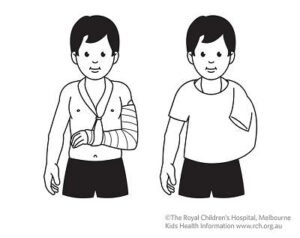
Illustration of a child with a cast immobilized arm in a cast. The child on the left is shown with a bandaged arm in a sling.. The child on the right is wearing a t-shirt over the sling,.
If your child has suffered a break in the bone (fracture) just above their elbow this is called a supracondylar elbow fracture.

If the fracture is undisplaced, this means the bones are still aligned. These fractures can be managed in a collar and cuff or a cast and a sling.

If the bones are out of alignment they are displaced. They may need surgery to have pins inserted which will hold the bones in place while the fracture heals.

They will then be placed in a full cast and a sling will be provided.

The cast and sling should be place under clothing and not passed through a sleeve.

Using crutches

· Nov 5, 2024 ·

To stand up

Hold both crutches by the handrest in one hand.

Use free hand to push up from the chair.

When standing

Transfer one crutch to each hand.

Reverse manoeuvre this to sit down.

You should have been told whether to be ‘non-weight bearing’ meaning you should not put any pressure through the sore or broken side at all, or ‘partial weight bearing’ meaning you can put gentle pressure through, using the crutches as support.

Non-weight bearing:

  • The ‘bad’ leg is not put to the ground. Hold it slightly in front of you with the knee slightly bent.
  • Stand on your ‘good’ leg.
  • Move both crutches forward keeping them apart and level.
  • Move your body forwards between the crutches allowing your ‘bad’ leg to swing through.

Partial weight bearing:

  • Move both crutches forward keeping them apart and level.
  • Place your “bad” leg on the ground, level with the crutches.
  • Step forward with your “good” leg.
  • « Go to Previous Page
  • Page 1
  • Page 2
  • Page 3
  • Page 4
  • Page 5
  • Page 6
  • Interim pages omitted …
  • Page 11
  • Go to Next Page »
NHS Lothian and EHCH logos
  • Facebook
  • Instagram
  • Twitter

More Information

  • About Us
  • Accessibility statement
  • Freedom of Information (FOI)
  • Disclaimer

Contact NHS Lothian

Main Switchboard: 0131 536 1000

  • About Us
Manage Cookie Consent
We use cookies to optimise our website and our service.
Functional Always active
The technical storage or access is strictly necessary for the legitimate purpose of enabling the use of a specific service explicitly requested by the subscriber or user, or for the sole purpose of carrying out the transmission of a communication over an electronic communications network.
Preferences
The technical storage or access is necessary for the legitimate purpose of storing preferences that are not requested by the subscriber or user.
Statistics
The technical storage or access that is used exclusively for statistical purposes. The technical storage or access that is used exclusively for anonymous statistical purposes. Without a subpoena, voluntary compliance on the part of your Internet Service Provider, or additional records from a third party, information stored or retrieved for this purpose alone cannot usually be used to identify you.
Marketing
The technical storage or access is required to create user profiles to send advertising, or to track the user on a website or across several websites for similar marketing purposes.
  • Manage options
  • Manage services
  • Manage {vendor_count} vendors
  • Read more about these purposes
Preferences
  • {title}
  • {title}
  • {title}