Parents and guardians
Feeding Difficulties in Babies
Trusted Resources
- General feeding support
- Information and videos on breastfeeding, bottle feeding and night-time care
- Information on posseting or baby reflux and things you can do to ease symptoms
- Off to a good start: all you need to know about breastfeeding
- Feeding my baby
- Support with formula feeding
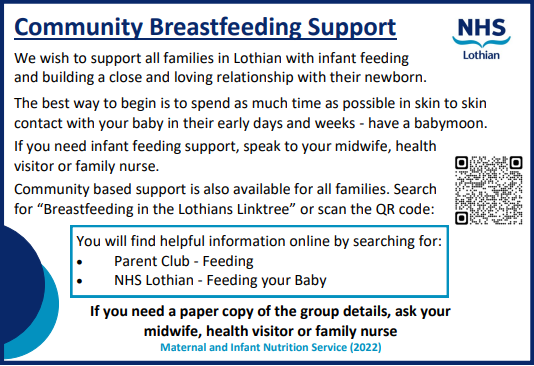
Community Breastfeeding Support
We wish to support all families in Lothian with infant feeding and building a close and loving relationship with their newborn.
The best way to begin is to spend as much time as possible in skin-to-skin contact with your baby in their early days and weeks – have a babymoon.
If you need infant feeding support, speak to your midwife, health visitor or family nurse.
Community-based support is also available for all families. Visit “Breastfeeding in the Lothians Linktree“.
You will find helpful information online by searching for:
- Parent Club – Feeding
- NHS Lothian – Feeding Your Baby
If you need a paper copy of the group details, ask your midwife, health visitor or family nurse.
Download Community Breastfeeding Support Leaflet
Breastfeeding
Breastfeeding is extremely powerful in establishing a strong mother-baby bond and provides your baby with the nutrients and energy they need to live and grow. Each baby feeds differently, and there is no such thing as “normal” breastfeeding.
Characteristics that indicate healthy, successful breastfeeding in a baby over 7 days old include:
- 5-40 minutes for each feed
- At least 8 feeds or more per 24 hours
- Feeding from both breasts at every feed
- Deep rhythmic sucks and swallowing
- Comes off the breast on their own
- Around 6 heavy wet nappies per day
- Passing stool regularly (at least two £2 coin-sized stools per day when under 6 weeks old)
- Gaining weight
UNICEF have excellent online resources for establishing successful breastfeeding called “Baby Friendly Resources“.
If you are concerned about your baby’s breastfeeding, ask your health visitor or midwife for advice. Seek advice in particular if your baby:
- Always falls asleep on the breast/never finishes the feed
- Comes on and off the breast frequently.
Crying
Every baby cries, and some babies cry more than others. Babies tend to cry most at about 7 weeks. Reasons for a baby to cry include hunger, a dirty nappy, being tired, wanting a cuddle, wind, or boredom.
Learning to recognise when your baby is hungry will help to reduce their crying. Early signs of hunger include:
- Rooting
- Wriggling
- Sucking fingers
- Mouth opening.
You can try to soothe your crying baby by:
- Letting your baby suckle
- Holding your baby close
- Using skin-to-skin contact
- Rocking gently.
Colic is defined as excessive, frequent crying in a baby who appears to be otherwise healthy and well-fed. It affects 1 in 5 babies and stops at around 4-6 months. Looking after a baby with colic can be difficult and tiresome, so it is important to seek support from family and friends.
Vomiting
It can be normal for babies to vomit. Babies can vomit for many reasons, including reflux, overfeeding, allergy or infection (either in the gut or elsewhere). If your baby starts to vomit, keep a close eye on them and try to feed your baby little and often.
If you are concerned about your baby’s vomiting, ask your health visitor, pharmacist or GP for advice. Seek urgent advice in particular if your baby:
- Has sick that’s green or has blood in it
- Has blood in their poo
- Has a swollen or tender tummy
- Has a high temperature
- Keeps being sick and can’t keep fluid down
- Has signs of dehydration
- Will not stop crying and is very distressed
- Is refusing to feed
- Stops having wet nappies.
Reflux
Many babies bring up some milk after feeding – this is called posseting. It is sometimes also called baby reflux and is usually nothing to worry about. It happens because muscles at the base of your baby’s food pipe have not fully developed, so milk can come back up easily. It occurs during the first year of life and improves with age.
You can help reduce posseting by burping your baby frequently, holding your baby upright during and after feeding, and reducing active play after feeding. NHS.co.uk have a useful article called “Reflux in babies“.
If you are concerned about your baby’s vomiting or if your baby is distressed, ask your health visitor or pharmacist for advice. They may suggest treatments such as a thickening powder or medicines. Make an appointment with your GP if your baby:
- Is not improving after 2 weeks of trying things to ease reflux
- Starts having reflux for the first time after they’re 6 months old
- Is older than 1 year and still has reflux
- Is not gaining weight or is losing weight.
Cow’s milk protein allergy
Cow’s milk protein allergy (CMPA) is rare in babies (approximately 2%). It is caused by the baby’s immune system reacting to the proteins in cow’s milk. There are 2 types of CMPA: immediate reaction and delayed reaction.
In an immediate reaction, the baby will develop symptoms usually within an hour after ingesting dairy. Symptoms include an itchy rash, swelling of the mouth/lips and vomiting.
In a delayed response, symptoms occur up to 72 hours after ingesting dairy. There are often several symptoms, including vomiting, abdominal pain, constipation/diarrhoea, bloody stool, poor growth, and rashes. If you are concerned about CMPA, ask your health visitor, pharmacist or GP for advice.
There is no medical test that can accurately diagnose CMPA. If your doctor thinks your baby might have CMPA, they may suggest that you eliminate dairy products from your baby’s diet.
If your baby has CMPA, it can take up to 4 weeks for dairy avoidance to improve symptoms. Soya milk should not be used as a dairy alternative in babies under 6 months old. Do not change your diet if you are breastfeeding without medical advice.
Baby-friendly accredited

The Royal Hospital for Children and Young People in Edinburgh were proud to receive Baby Friendly accreditation from UNICEF.


Other leaflets