• Skip to primary navigation
  • Skip to main content

Royal Hospital for Children and Young People

  • Home
    • Children
      • Coming to hospital
      • Being in hospital
      • Tests, Scans & X-rays
      • Having an operation
      • Going home
      • Wellbeing Hub
      • Health Resources
    • Young People
      • Coming to a clinic
      • Staying on a ward
      • Tests, Scans & X-rays
      • Going home
      • Transition to adult services
      • Wellbeing Hub
      • Health Resources
    • Parents and Carers
      • Accommodation for families
      • Financial Help & Advice
      • Charity support for children & families
      • Spiritual Care & The Sanctuary
      • Child Protection
      • Social Work
      • Play Service
      • Children with learning disabilities
      • Support and further information
      • Health Resources
  • Departments & Services
    • Community Services
    • Departments & Services
    • Health Resources
  • The RHCYP
    • Travel & Transport
    • Patient & Visitor Facilities
    • Wellbeing & further support
    • Radio Lollipop
    • Health Resources
  • Get Involved
    • About Us
    • ECH Charity
    • Family Council
    • Volunteer
    • Scottish Hospitals Inquiry
    • Radio Lollipop
  • Emergency Department
  • Show Search
  • Facebook
  • Twitter
Generic selectors
Exact matches only
Search in title
Search in content
Post Type Selectors
Search in posts
Search in pages
Filter by Categories
Accident and Emergency
Acorn Suite
Air Ambulance
Allergy
Anaesthetic
Asthma
Audiology
Bereavement Service
Blood Tests
Borthwick Ward
Brain
Breathing
Breathing support & Ventilation
CAMHS
Cardiology
Care Experienced Medical Team
Castle Mey Ward
Child Life & Health
Child Protection
Clinical Genetics
Clinical Research
Community Paediatrics
Community Services
Crichton Unit
Critical Care
Crohns
Cystic Fibrosis
Dalhousie Ward
Dental Service
Departments
Diabetes
Dietetics
Dirleton Ward
Discharge Planning Service
Dunvegan Ward
Ear Reconstruction
Emergency Department
Endocrinology
Epilepsy
Epilepsy Surgery
Gastroenterology (GI)
General Paediatrics
Haematology
Hepatology (Liver)
Hormones
IBD
Imaging Department (Scans & X-Rays)
Immunology and Infectious Diseases
Inflammatory Bowel Disease
Little France School
Lochranza
Major Trauma
Melville Unit
Neurodiversity
Neurosciences
Occupational Therapy
Oncology
Ophthalmology
Orthopaedics
Outpatients
Palliative Care
Pharmacy
Phlebotomy
Physiotherapy
Planned Investigations Unit
Plastic Dressings Clinic
Play
PPALS
Respiratory Department
Resuscitation Videos
Resuscitation Videos - British Sign Language (BSL)
Resuscitation Videos – Arabic
Resuscitation Videos – Bengali
Resuscitation Videos – Bulgarian
Resuscitation Videos – Cantonese
Resuscitation videos – English
Resuscitation Videos – Mandarin
Resuscitation Videos – Polish
Resuscitation Videos – Romanian
Resuscitation Videos – Spanish
Resuscitation Videos – Urdu
Rheumatology
Scans & X-Rays
Sleep
Social Work
Speech and Language Therapy
Spiritual Care
St John’s Hospital
Surgery
Trauma Service
Vision and Development
Hide Search

Unsettled Baby

Normal Baby Behaviour

· May 18, 2026 ·

Trusted Resources

  • General feeding support
  • Information and videos on breastfeeding, bottle feeding and night-time care
  • Off to a good start: all you need to know about breastfeeding
  • Feeding my baby
  • Support with formula feeding
  • Information about safer sleep for babies
  • A huge range of support from feeding to surviving the first few weeks with a newborn, and common problems
  • Support in managing a crying baby

Feeding Cues

Babies know when they are hungry and full, so try to tune into the signals they give you. The leaflet below explains some common cues babies use to show they are hungry and ready to feed.

Off to a Good Start leaflet

Pooing

Normal baby pooing is very variable. We would usually expect around two £2 coin-sized dirty nappies in 24 hours in the early days of life, but this will vary depending on the baby. You should see your health visitor or GP if the poos are hard or infrequent (less than 2-3 per week).

Skin to skin

Skin to skin contact can be very helpful to calm both baby and parent – and it’s important for both parents to do this with the baby to help with relationship building, minimising stress, brain development and supporting the baby’s immune system to develop. There is no such thing as too much skin-to-skin!

Crying

Every baby cries, and some babies cry more than others. Babies tend to cry most at about 7 weeks. Reasons for a baby to cry include hunger, a dirty nappy, being tired, wanting a cuddle, wind, or boredom.

Learning to recognise when your baby is hungry will help to reduce their crying. Early signs of hunger include:

  • Rooting
  • Wriggling
  • Sucking fingers
  • Mouth opening.

You can try to soothe your crying baby by:

  • Letting your baby suckle
  • Holding your baby close
  • Using skin-to-skin contact
  • Rocking gently.

Colic is defined as excessive, frequent crying in a baby who appears to be otherwise healthy and well-fed. It affects 1 in 5 babies and stops at around 4-6 months. Looking after a baby with colic can be difficult and tiresome, so it is important to seek support from family and friends.

Crying can be overwhelming, so it is important to know how to cope.

  • Infant crying is normal
  • Comforting methods can help
  • It’s okay to walk away
  • Never, ever shake a baby

For more information and support, visit ICON

Feeding Difficulties in Babies

· Jun 18, 2025 ·

Trusted Resources

  • General feeding support
  • Information and videos on breastfeeding, bottle feeding and night-time care
  • Information on posseting or baby reflux and things you can do to ease symptoms
  • Off to a good start: all you need to know about breastfeeding 
  • Feeding my baby
  • Support with formula feeding

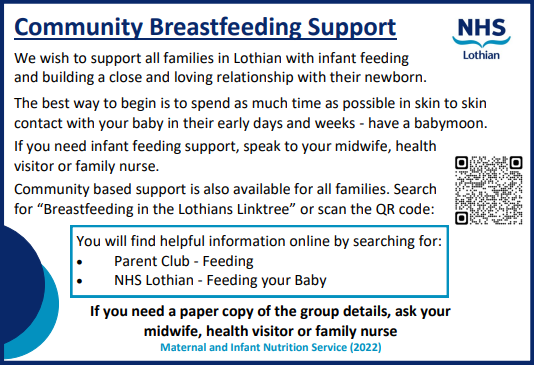
Community Breastfeeding Support

We wish to support all families in Lothian with infant feeding and building a close and loving relationship with their newborn.

The best way to begin is to spend as much time as possible in skin-to-skin contact with your baby in their early days and weeks – have a babymoon.

If you need infant feeding support, speak to your midwife, health visitor or family nurse.

Community-based support is also available for all families. Visit “Breastfeeding in the Lothians Linktree“.

You will find helpful information online by searching for:

  • Parent Club – Feeding
  • NHS Lothian – Feeding Your Baby

If you need a paper copy of the group details, ask your midwife, health visitor or family nurse.

Download Community Breastfeeding Support Leaflet 

Breastfeeding

Breastfeeding is extremely powerful in establishing a strong mother-baby bond and provides your baby with the nutrients and energy they need to live and grow. Each baby feeds differently, and there is no such thing as “normal” breastfeeding.

Characteristics that indicate healthy, successful breastfeeding in a baby over 7 days old include:

  • 5-40 minutes for each feed
  • At least 8 feeds or more per 24 hours
  • Feeding from both breasts at every feed
  • Deep rhythmic sucks and swallowing
  • Comes off the breast on their own
  • Around 6 heavy wet nappies per day
  • Passing stool regularly (at least two £2 coin-sized stools per day when under 6 weeks old)
  • Gaining weight

UNICEF have excellent online resources for establishing successful breastfeeding called “Baby Friendly Resources“.

If you are concerned about your baby’s breastfeeding, ask your health visitor or midwife for advice. Seek advice in particular if your baby:

  • Always falls asleep on the breast/never finishes the feed
  • Comes on and off the breast frequently.

Crying

Every baby cries, and some babies cry more than others. Babies tend to cry most at about 7 weeks. Reasons for a baby to cry include hunger, a dirty nappy, being tired, wanting a cuddle, wind, or boredom.

Learning to recognise when your baby is hungry will help to reduce their crying. Early signs of hunger include:

  • Rooting
  • Wriggling
  • Sucking fingers
  • Mouth opening.

You can try to soothe your crying baby by:

  • Letting your baby suckle
  • Holding your baby close
  • Using skin-to-skin contact
  • Rocking gently.

Colic is defined as excessive, frequent crying in a baby who appears to be otherwise healthy and well-fed. It affects 1 in 5 babies and stops at around 4-6 months. Looking after a baby with colic can be difficult and tiresome, so it is important to seek support from family and friends.

Vomiting

It can be normal for babies to vomit. Babies can vomit for many reasons, including reflux, overfeeding, allergy or infection (either in the gut or elsewhere). If your baby starts to vomit, keep a close eye on them and try to feed your baby little and often.

If you are concerned about your baby’s vomiting, ask your health visitor, pharmacist or GP for advice. Seek urgent advice in particular if your baby:

  • Has sick that’s green or has blood in it
  • Has blood in their poo
  • Has a swollen or tender tummy
  • Has a high temperature
  • Keeps being sick and can’t keep fluid down
  • Has signs of dehydration
  • Will not stop crying and is very distressed
  • Is refusing to feed
  • Stops having wet nappies.

Reflux

Many babies bring up some milk after feeding – this is called posseting. It is sometimes also called baby reflux and is usually nothing to worry about. It happens because muscles at the base of your baby’s food pipe have not fully developed, so milk can come back up easily. It occurs during the first year of life and improves with age.

You can help reduce posseting by burping your baby frequently, holding your baby upright during and after feeding, and reducing active play after feeding. NHS.co.uk have a useful article called “Reflux in babies“.

If you are concerned about your baby’s vomiting or if your baby is distressed, ask your health visitor or pharmacist for advice. They may suggest treatments such as a thickening powder or medicines. Make an appointment with your GP if your baby:

  • Is not improving after 2 weeks of trying things to ease reflux
  • Starts having reflux for the first time after they’re 6 months old
  • Is older than 1 year and still has reflux
  • Is not gaining weight or is losing weight.

Cow’s milk protein allergy

Cow’s milk protein allergy (CMPA) is rare in babies (approximately 2%). It is caused by the baby’s immune system reacting to the proteins in cow’s milk. There are 2 types of CMPA: immediate reaction and delayed reaction.

In an immediate reaction, the baby will develop symptoms usually within an hour after ingesting dairy. Symptoms include an itchy rash, swelling of the mouth/lips and vomiting.

In a delayed response, symptoms occur up to 72 hours after ingesting dairy. There are often several symptoms, including vomiting, abdominal pain, constipation/diarrhoea, bloody stool, poor growth, and rashes. If you are concerned about CMPA, ask your health visitor, pharmacist or GP for advice.

There is no medical test that can accurately diagnose CMPA. If your doctor thinks your baby might have CMPA, they may suggest that you eliminate dairy products from your baby’s diet.

If your baby has CMPA, it can take up to 4 weeks for dairy avoidance to improve symptoms. Soya milk should not be used as a dairy alternative in babies under 6 months old. Do not change your diet if you are breastfeeding without medical advice.

Baby-friendly accredited

A group of healthcare staff stand around a man in a suit who is seated at an outdoor table signing a document. The group is smiling and posing together outside a hospital building on a sunny day.

The Royal Hospital for Children and Young People in Edinburgh were proud to receive Baby Friendly accreditation from UNICEF.

Unsettled baby

· Jun 18, 2025 ·

Having an unsettled baby is really common. It’s important to know what is normal, when to worry and what you can do to help. It is normal for a crying baby to make you feel overwhelmed. It’s okay to put your baby down in a safe place and walk away. Never shake your baby.

The ICON website is an incredibly helpful resource with great information to help you understand and manage your crying baby and your own well being.

When to worry:

  • Fever
  • Vomiting
  • Working hard to breathe
  • Rash that doesn’t go away when you press on it
  • Floppiness
  • Poor feeding
  • Gut feeling that something is wrong – you know your baby best!

Discomfort When Pooing (Dyschezia) in Babies

· Jun 18, 2025 ·

Infant dyschezia is a common problem seen in up to 10% of babies under 1 year, usually between 1 and 9 months of age. Dyschezia is a medical term for apparent discomfort around the time that a baby has a poo. It can often be mistaken for constipation, as the baby will cry, strain, and go red in the face for several minutes (up to half an hour) before passing a stool. However, it is different to constipation because the stool is soft (not hard) and the baby usually opens their bowels everyday or every other day.

Why does it happen?

Dyschezia happens because the baby is still developing their muscles in their abdominal wall (tummy) and their pelvic floor (bottom). These need to work together to allow the baby to pass stool comfortably. It is a process – just like learning to roll, walk and talk. For this reason it can take several weeks or months to fully resolve.

What NOT to do

If the stools are soft, there is no point in using laxatives or other medications for this condition – they won’t help the muscle coordination develop any faster. It’s also not helpful (and can be very harmful) to use cotton buds, suppositories, or other instruments in the baby’s bottom to relieve the stools.

What you CAN do

Some parents find that gently cycling their baby’s legs up to their belly can help (this probably helps relax the pelvic floor). Otherwise, your baby will benefit from any soothing comfort while they are crying– cuddles, talking/singing, a warm bath, carrying around, or sucking on a dummy if they have one. It might help to know that there is a theory that the crying is helpful to the baby because it increases the pressure in their abdomen which helps pass the stool – and is not necessarily a sign of pain or distress.

When to see your Health Visitor or GP

  • If the stools are hard or infrequent (less than 2-3 per week)
  • If the abdomen is very large (distended)
  • If there is lots of vomiting, or any green vomiting


NHS Lothian and EHCH logos
  • Facebook
  • Instagram
  • Twitter

More Information

  • About Us
  • Accessibility statement
  • Freedom of Information (FOI)
  • Disclaimer

Contact NHS Lothian

Main Switchboard: 0131 536 1000

  • About Us
Manage Cookie Consent
We use cookies to optimise our website and our service.
Functional Always active
The technical storage or access is strictly necessary for the legitimate purpose of enabling the use of a specific service explicitly requested by the subscriber or user, or for the sole purpose of carrying out the transmission of a communication over an electronic communications network.
Preferences
The technical storage or access is necessary for the legitimate purpose of storing preferences that are not requested by the subscriber or user.
Statistics
The technical storage or access that is used exclusively for statistical purposes. The technical storage or access that is used exclusively for anonymous statistical purposes. Without a subpoena, voluntary compliance on the part of your Internet Service Provider, or additional records from a third party, information stored or retrieved for this purpose alone cannot usually be used to identify you.
Marketing
The technical storage or access is required to create user profiles to send advertising, or to track the user on a website or across several websites for similar marketing purposes.
  • Manage options
  • Manage services
  • Manage {vendor_count} vendors
  • Read more about these purposes
Preferences
  • {title}
  • {title}
  • {title}