
Information for patients
Wrist/Hand sprain
What is a sprain?

A sprained hand or wrist is an injury that occurs when you fall or catch your hand, causing it to move or be pulled in an awkward way. This can stretch or damage the tough bands of tissue (ligaments) that help hold your bones together.
Ligaments help stabilise joints, preventing excessive movement. A sprain occurs when the ligaments are forced beyond their normal range of motion.
Treatment for a sprain depends on the severity of the injury but most recover well with a little time to recover and then simple rehab exercises once the pain has settled.
What is the best treatment?
Immediately after a wrist or hand injury, it is important to manage it correctly, it is very important to keep your hand and wrist moving as best as possible as well as trying to reduce the pain and swelling.
The current guidance on treating soft tissue injuries follows PEACE and LOVE principles.
PEACE
- Protection – Avoid activities and movements that increase pain during the first few days after injury.
- Elevation – Raise the injured limb higher than the heart as often as possible.
- Avoid Anti-Inflammatories – Avoid taking anti-inflammatory medications as they reduce tissue healing. Avoid icing.
- Compression – Use elastic bandage or taping to reduce swelling.
- Education – Your body knows best. Avoid unnecessary passive treatments and medical investigations and let nature play its role.
LOVE
- Load – Let pain guide your gradual return to normal activities. Your body will tell you when it is safe to increase load.
- Optimism – Condition your brain for optimal recovery by being confident and positive.
- Vascularisation – Choose pain-free cardiovascular activities to increase blood flow to repairing tissues.
- Exercise – Restore mobility, strength and proprioception by adopting an active approach to recovery.
What if I need pain relief?
To manage your pain and keep your hand and wrist moving it is advised that you initially take regular simple pain relief. This can be bought over the counter from a pharmacist.
If you have any allergies or conditions which affect the use of pain relief or any questions or concerns please seek advice from your general practitioner (GP) or a pharmacist.
Rehabilitation and recovery
If you follow this advice leaflet your injury should take around 8-10 weeks to heal. However, everyone recovers from injuries at different rates and it is dependent on the severity of the injury, the soft tissue that was involved and the presence of any other medical problems.
0 – 2 weeks after injury
If you have been given a splint in the Emergency Department (ED), use this as required in the early stages. You should attempt to wean off it as soon as possible and resume normal activities as soon as your hand and wrist feel comfortable and you feel able to.
It is safe to move and use your arm as much as you feel able to for day-to-day things like washing your hair, cleaning your teeth and using a knife and fork.
2 – 4 weeks after injury
Start to try and add in some gentle cardiovascular activity like swimming or walking as you feel able to as well as keeping other parts of your body moving like doing core stability exercises or lower body exercises.
If after 2-3 weeks, you are still struggling with any of the following, please contact the physiotherapy department on 0131 3121079 and ask to make a self-referral:
- Still having difficulty fully moving your hand or wrist in all directions.
- Still have significant swelling
- Are unable to use your arm for normal tasks like using a knife and fork, brushing your hair or cleaning your teeth
4+ weeks after injury
If you have followed all of the exercises within this guide and gradually built up your activity levels it is safe to start re-introducing more challenging activities such as gently returning to some sports activities and physical education (PE) as you feel able to.
You can also start adding in more sport-specific activities as you feel able to and make a gradual return to training.
Remember to always be guided by your hand and wrist – a little bit of pain that goes away quickly is normally nothing to worry about but if you are experiencing high levels of pain that don’t settle quickly you should contact the physiotherapy department on 0131 3121079
Initial exercises
Try and start working through the following exercises as soon as you can – it is safe to start trying these exercises right from the day after your injury.

Exercise 1
Sit or stand with the palms of your hands together, try and gradually work towards the position pictured by moving
your hands up and down from your chin and down towards your tummy.
This may feel stiff initially and will take some practice but it should improve over time.
Repeat 3×10 times, twice a day.

Exercise 2
Sit or stand with the backs of your hands together, try and gradually work towards the position pictured by moving
your hands up and down from your chin and down towards your tummy.
This may feel stiff initially and will take some practice but it should improve over time.
Repeat 3×10 times, twice a day.

Exercise 3
Sit or stand with your hands clasped together as pictured, practice turning your hands over and back so the back of each hand in turn touches the table.
This may be stiff and sore to begin with but keep practicing as it will get easier.
Repeat 3×10 times, twice a day.

Exercise 4
Practice squeezing a ball or clothes peg between your fingers. This will help strengthen the muscles in your hands and wrists if you do it regularly throughout the day.
Repeat 3-4 x10 every day.
Physiotherapy video
Exercises progressions
Start these exercises as soon as your movement has returned and your pain is starting to settle.

Wall ball exercise
Practice throwing and catching a ball with your injured arm, either against a wall or with a partner.
Practice throwing at different heights and different speeds as well as over-arm and underarm throws.
Try and see how many times you can throw and catch without dropping the ball
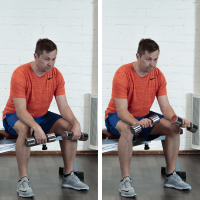
Wrist extension with a small weight
Sit on a bench with your forearms supported on your thighs and wrists hanging over your knees.
Hold a small weight or water bottle in both hands with your palms facing downwards and wrists in a neutral position (straight line from elbow to knuckles).
Gently lift the weight up and down by moving your wrist.
Repeat 3×10 times.

Wrist movement side to side with a small weight
Sit on a bench with your forearms supported on your thighs and wrists hanging over your knees. Hold a small weight or water bottle in both hands with your palms facing upwards and wrists at a neutral position (straight line from elbow to knuckles).
Turn your hand and wrist over so your palm is facing downwards and then back to the start position.
Repeat 3×10 times

Holding the front end of a dumbbell with a straight arm
Bend your wrist sideways so that your little finger approaches your elbow and the other end of the dumbbell raises.
Lower the other end of the dumbbell and let your wrist hand back to the starting position.
Physiotherapy video
Return to sports and activity
Once your hand and wrist are no longer painful and the movement is much better you can gradually return to gentle activities.
As your hand and wrist continue to feel better you can gradually return to your usual activities like sports and PE ensuring you warm up and cool down fully.
If you feel as though you are able to you do not have to wait for the go-ahead from a health professional to return to your normal activities.
Do I require further treatment?
If you have regained full movement at your hand and wrist, are able to use it for all normal activities pain-free you likely don’t need any further assessment or treatment.
If you do have any concerns, or ongoing pain or are struggling to return to your normal activities please call the physiotherapy department to speak with one of our physios and make a self-referral.
Contact information
Other leaflets


