
Information for patients
Shoulder dislocation
What is a shoulder dislocation?
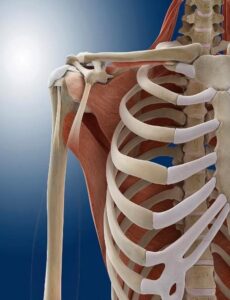
The shoulder is made up of a ball and socket joint where the ball sits in a very shallow socket. This allows the arm to be very mobile and move in all directions, but also means that it is not very stable making it one of the easiest joints in the body to dislocate.
A dislocated shoulder happens when the bone in your upper arm moves partially or fully out of the shoulder socket. This normally happens if you fall on your arm heavily, commonly during contact sports like rugby or judo.
In younger people with very flexible joints, this can happen more easily with some people even able to voluntarily move their arm in and out of the joint.
Sometimes the shoulder will pop back into place by itself but sometimes people need help from a paramedic or in the Emergency Department.
Shoulder dislocations can lead to pain, swelling and bruising which may make it sore to move your arm and stop you from using it normally for a few weeks.
What is the best treatment?
Immediately after a shoulder subluxation, it is important to manage it correctly. Unless you have been advised otherwise by a doctor or physio it is very important to keep your shoulder gently moving as best as possible as well as trying to reduce the pain and swelling.
The current guidance on treating injuries such as shoulder subluxations follows the PEACE and LOVE principles.
PEACE
- Protection – Avoid activities and movements that increase pain during the first few days after injury.
- Elevation – Raise the injured limb higher than the heart as often as possible. You can support this with pillows.
- Avoid Anti-Inflammatories – Avoid taking anti-inflammatory medications such as ibuprofen and icing the injury as they can reduce tissue healing in the early stages.
- Compression – Use elastic bandages or taping to reduce swelling.
- Education – Your body knows best. Let nature play its role. Seek advice and support from healthcare professionals regarding how to approach recovery.
LOVE
- Load – Let pain guide your gradual return to normal activities. Your body will tell you when it is safe to increase.
- Optimism – Condition your brain for optimal recovery by being confident and positive.
- Vascularisation – Choose pain-free cardiovascular activities to increase blood flow to repairing tissues.
- Exercise – Restore mobility, strength and proprioception by adopting an active approach to recovery
What if I need pain relief?
To manage your pain and keep your shoulder moving it is advised that you initially take regular simple pain relief. This can be bought over the counter from a pharmacist.
If you have any allergies or conditions which affect the use of pain relief or any questions or concerns please seek advice from your general practitioner (GP) or a pharmacist.
Rehabilitation and recovery
If you follow this advice leaflet your injury should take around 8-10 weeks to heal.
However, everyone recovers from injuries at different rates and it is dependent on the severity of the injury, the soft tissue that was involved and the presence of any other medical problems.
0-2 weeks after injury
If you have been given a sling in the Emergency Department (ED) use this as required in the early stages. You should attempt to wean off it as soon as possible and resume normal activities as soon as your shoulder feels comfortable and you feel able to.
2-4 weeks after injury
Start to try and add in some gentle cardiovascular activity like static cycling or walking as you feel able to as well as keeping other parts of your body moving like doing core stability exercises or lower body exercises if you have access to a gym.
If after 2-3 weeks, you are still struggling with any of the following, please contact the physiotherapy department on 0131 3121079 and ask to make a self-referral:
- Still having difficulty fully moving your arm in all directions.
- Still have significant swelling
- Are unable to use your arm for normal tasks like using a knife and fork, brushing your hair or cleaning your teeth
- Have a feeling that your shoulder is unstable and moving in and out of joint when you are trying to use your arm.
4+ weeks after injury
If you have followed all of the exercises within this guide and gradually built up your activity levels it is safe to start re-introducing more challenging activities such as gently returning to some sports activities and PE as you feel able to.
You can also start adding in more sport-specific activities as you feel able to and make a gradual return to training and physical education (PE).
Remember to always be guided by your shoulder – a little bit of pain that goes away quickly is normally nothing to worry about but if you are experiencing high levels of pain that don’t settle quickly or if your shoulder feels unstable in any way you should contact the physiotherapy department on 0131 3121079.
Initial exercises
Try and start working through the following exercises as soon as you can – it is safe to start trying these exercises right from the day after your injury.
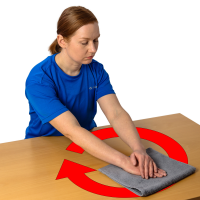
Exercise 1
- Sit with your hands on a table with your good hand on top of your injured hand and place something slidey under your hands.
- Move your hands around in as big a circles as you can manage so your shoulder moves forwards, backwards, out to the side and across your body.
- You may initially have to start with small movements but make them bigger as your arm feels more comfortable
Repeat 3×10 times, twice a day.

Exercise 2
- Lie on your side with your injured arm on top of your other hand.
- Reach forwards as far as you can then reach your arm up and out to the side.
- Return to the starting position
- You may initially have to start with small movements but make them bigger as your arm feels more comfortable.
Repeat 3×10 times, twice a day.

Exercise 3
- Kneel on your hands and knees with your weight evenly spread between all four limbs.
- Alternately lift one arm then the other arm up as far as you can. This will strengthen your arm both arms so you should practice lifting both your injured and non-injured arms.
- When this feels easy you can progress to lifting the opposite leg as well as your arm.
Repeat 3×10 times, twice a day.
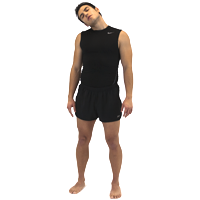
Exercise 4
Sometimes your neck can start to feel stiff if you are sore after hurting your shoulder.
In standing or sitting move your head from side to side holding a stretch for approximately 30 seconds in each direction so you can feel a stretch down the side of your neck.
Physiotherapy video
Exercises progressions
Start these exercises as soon as your movement has returned and your pain is starting to settle.

Exercise 1
- Practice throwing and catching a ball with your injured arm, either against a wall or with a partner.
- Practice throwing at different heights and different speeds as well as overarm and underarm throws.
- Try and see how many times you can throw and catch without dropping the ball.

Exercise 2
- Take weight through your hands on the floor in a plank position.
- Move your weight over one arm and tap the hand or shoulder of the arm you are weight-bearing through then repeat on the other side.
Repeat 3×10 times a day.
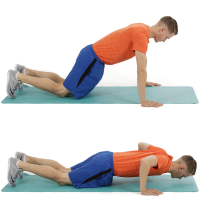
Exercise 3 ‘Press ups’
- These can be done on your knees initially and then progressed to on your feet as you start to feel more comfortable.
- You can also practice having your hands wide out to the side or close into your body as this will strengthen different muscles.
Repeat 3×10 times a day.

Exercise 4 ‘Squats’
It is important to keep your leg and back muscles strong while your arm recovers.
- Practice squatting but lifting your arms up above your head
as you do so. - If you have something you can hold between your hands as you lift them this is even better.
- You can use an exercise band, ball or broom handle.
Repeat 3×10 times a day.
Physiotherapy video
Return to sports and activity
Once your shoulder is no longer painful and the movement is much better you can gradually return to gentle activities.
As your shoulder continues to feel better you can gradually return to your usual activities like sports and physical education (PE) ensuring you warm up and cool down fully.
If you feel as though you are able to you do not have to wait for the go-ahead from a health professional to return to your normal activities.
Do I require further treatment?
If you have regained full movement at your shoulder, are able to use if for all normal activities pain-free and don’t have any feelings of instability you likely don’t need any further assessment or treatment.
If you do have any concerns, ongoing pain or are struggling to return to your normal activities please call the physiotherapy department to speak with one of our physios and make a self-referral.
Physiotherapy Team
Therapies Department,
Royal Hospital for Children and Young People,
50 Little France Crescent
Edinburgh
EH16 4SA
Telephone: 0131 312 1079
Other leaflets


