
Information for patients
Osgood Schlatter disease
What is Osgood Schlatters?
Osgood Schlatter’s Disease (OSD) is a common cause of knee pain in children and adolescents. It is not yet known exactly what causes OSD but it is thought to be caused by repeated stress of your large thigh muscle tendon where it attaches to the top of your shin bone below your kneecap.
Often this occurs in sporty adolescents or during a rapid growth spurt. This stress results in this area becoming inflamed and painful. At times a hard, bony bump may appear in this area. This is generated as healing occurs and new bone is created.
Who gets Osgood Schlatter’s?
- Children and adolescents going through a large growth spurt.
- Children aged 9-15 with a greater incidence in boys.
- Children and adolescents who participate in repeated high-intensity activity with higher impact such as hopping, jumping and change of direction.
- Higher incidence in athletes who specialise in only one sport early.
What are the most common symptoms?
- Knee pain either during or after participation in sports which typically eases with rest.
- Swelling or a bump at the top of your shin bone which can be tender to touch.
- Reduced knee strength.
- Tightness of your leg muscles.
These symptoms usually come on gradually and can appear in one or both of your knees.
What is the best treatment?
By following the steps below your knee pain should start to settle.
- Place some crushed ice in a damp towel and place on the painful area for 10-15 minutes. Please check your skin regularly during this time to make sure it isn’t getting too cold. Repeat this ice application every 2–3 hours as required.
- Start a daily stretching programme as detailed on this page to improve your muscle flexibility.
- We would advise that you rest from high-impact activities such as running and jumping which may increase your pain for around 4-6 weeks to enable the pain and swelling to settle.
- However, continuing with sport at a lower level is not harmful in most cases as long as it does not cause an increase in your pain. In most people, it actually helps you stay fitter and stronger.
- It is important to remain involved with teams and clubs so if you are finding it is too sore to run and jump, try and find a role you can do whilst injured. To help with this you can use a pain scale of 0-10 where 10 is severe pain and 0 is no pain at all. Your pain during your activities should not be greater than 3 out of 10.
Daily stretching programme
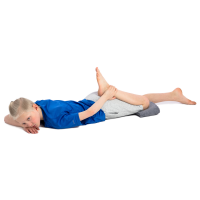
Exercise 1
- Lie face down.
- Bend your painful knee back and place your hand around your ankle.
- Pull your heel slowly towards your bottom until you feel the stretching on the front of your thigh.
- Hold for 30 seconds and then relax.
Repeat 3 times in a row, daily.
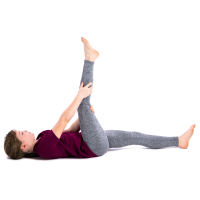
Exercise 2
- Lie on your back.
- Lift your painful leg towards your chest.
- Place your hands behind your knee (as shown).
- Gently straighten your knee until you feel a gentle stretch behind your thigh.
- Hold for approximately 30 seconds and then relax.
Repeat 3 times in a row, daily.

Exercise 3 ‘Standing Calf Stretch’
- Stand tall and take a long step forward.
- Move your weight forward but keep the heel of the rear leg on the floor and feel a stretch in your calf.
- Return to the starting position.
Hold for 30 seconds and repeat 2-3 times each leg.
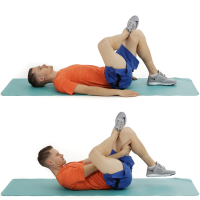
Exercise 4 ‘Gluteus Stretch’
- Lie on your back with your legs bent.
- Place one ankle over the knee of the other leg.
- Grasp behind the thigh of the leg on the floor and pull it closer to your chest.
- Maintain the stretching position while breathing smoothly.
- Return to the starting position.
Note: You may rest your head on a pillow or on the floor.
Hold for 30 seconds and repeat 2-3 times each leg.
Physiotherapy video
Return to sport journey
Getting back to the sport may take some time and might involve ups and downs. The body often takes a little time to build back up to normal levels of activity after being injured and it is important to build up slowly to allow your body to strengthen and adapt.
Start with some walking, swimming, cycling and then gentle running. You may need to ease into training sessions and just participate in some of the sessions initially until you have built your fitness back up.
If you find that your pain flares up again, just reduce your activity levels again, allow it to settle and try again once you feel able to.
Managing physical activity levels
Managing the amount of high-intensity exercise you participate in each week will allow your body to properly recover. After holidays and injuries remember to build back up to normal levels of activity slowly.
A useful guide is to limit high-intensity activity to no more than 4 sessions per week and to try not to participate in high-intensity activities on 2 consecutive days. By planning recovery days you are allowing your body to get stronger, adapt and repair. Getting high-quality sleep is also a key factor in this.
Try to limit your total number of hours of structured sports per week to no greater than your age.
Download the ‘Managing physical activities levels table (DOCX)
Download the ‘Managing physical activities levels table (PDF)
Further advice
If you have followed all of the advice above and you are still struggling with your symptoms you can contact the physiotherapy department on details below.
Physiotherapy Team
Therapies Department,
Royal Hospital for Children and Young People,
50 Little France Crescent
Edinburgh
EH16 4SA
Telephone 0131 312 1079
Other leaflets


