• Skip to primary navigation
  • Skip to main content

Royal Hospital for Children and Young People

  • Home
    • Children
      • Coming to hospital
      • Being in hospital
      • Tests, Scans & X-rays
      • Having an operation
      • Going home
      • Wellbeing Hub
      • Health Resources
    • Young People
      • Coming to a clinic
      • Staying on a ward
      • Tests, Scans & X-rays
      • Going home
      • Transition to adult services
      • Wellbeing Hub
      • Health Resources
    • Parents and Carers
      • Accommodation for families
      • Financial Help & Advice
      • Charity support for children & families
      • Spiritual Care & The Sanctuary
      • Child Protection
      • Social Work
      • Play Service
      • Children with learning disabilities
      • Support and further information
      • Health Resources
  • Departments & Services
    • Community Services
    • Departments & Services
    • Health Resources
  • The RHCYP
    • Travel & Transport
    • Patient & Visitor Facilities
    • Wellbeing & further support
    • Radio Lollipop
    • Health Resources
  • Get Involved
    • About Us
    • ECH Charity
    • Family Council
    • Volunteer
    • Scottish Hospitals Inquiry
    • Radio Lollipop
  • Emergency Department
  • Show Search
  • Facebook
  • Twitter
Generic selectors
Exact matches only
Search in title
Search in content
Post Type Selectors
Search in posts
Search in pages
Filter by Categories
Accident and Emergency
Acorn Suite
Air Ambulance
Allergy
Anaesthetic
Asthma
Audiology
Bereavement Service
Blood Tests
Borthwick Ward
Brain
Breathing
Breathing support & Ventilation
CAMHS
Cardiology
Care Experienced Medical Team
Castle Mey Ward
Child Life & Health
Child Protection
Clinical Genetics
Clinical Research
Community Paediatrics
Community Services
Crichton Unit
Critical Care
Crohns
Cystic Fibrosis
Dalhousie Ward
Dental Service
Departments
Diabetes
Dietetics
Dirleton Ward
Discharge Planning Service
Dunvegan Ward
Ear Reconstruction
Emergency Department
Endocrinology
Epilepsy
Epilepsy Surgery
Gastroenterology (GI)
General Paediatrics
Haematology
Hepatology (Liver)
Hormones
IBD
Imaging Department (Scans & X-Rays)
Immunology and Infectious Diseases
Inflammatory Bowel Disease
Little France School
Lochranza
Major Trauma
Melville Unit
Neurodiversity
Neurosciences
Occupational Therapy
Oncology
Ophthalmology
Orthopaedics
Outpatients
Palliative Care
Pharmacy
Phlebotomy
Physiotherapy
Planned Investigations Unit
Plastic Dressings Clinic
Play
PPALS
Respiratory Department
Resuscitation Videos
Resuscitation Videos - British Sign Language (BSL)
Resuscitation Videos – Arabic
Resuscitation Videos – Bengali
Resuscitation Videos – Bulgarian
Resuscitation Videos – Cantonese
Resuscitation videos – English
Resuscitation Videos – Mandarin
Resuscitation Videos – Polish
Resuscitation Videos – Romanian
Resuscitation Videos – Spanish
Resuscitation Videos – Urdu
Rheumatology
Scans & X-Rays
Sleep
Social Work
Speech and Language Therapy
Spiritual Care
St John’s Hospital
Surgery
Trauma Service
Vision and Development
Hide Search

Hand and wrist

Scaphoid fracture

· Nov 6, 2024 ·

xray of a hand
We are concerned that your child has broken a bone in their hand called the scaphoid. These almost always heal without the need for surgery. The treatment for this is a cast for 6 weeks. You will be given an appointment for a fracture clinic in 6 weeks.

To ensure that orthopaedics (specialist bone doctors) are happy with this management plan your child’s x-rays will be looked at by the Orthopaedic Team in the next few days. If they want to make a change to the management plan, they will contact you to let you know.

If you do not hear from them, then continue in the cast until the follow-up appointment.

If you have any concerns regarding the cast, please phone 0131 312 0009. If you have any other concerns, please phone 0131 536 1000 and ask to be put through to the orthopaedic secretary.
Mallet finger in children and young people

· Nov 6, 2024 ·

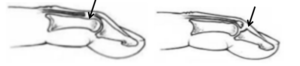
Two side-view anatomical illustrations of a finger with arrows pointing to the joint area. The first illustration shows a bent finger with the arrow highlighting the injured area, a tear of the the extensor tendon. The second illustration shows the finger in an extended position, with the arrow pointing to a broken bone in the finger tip.
Mallet finger is an injury to the end of a finger. It happens when an object, like a ball, hits the tip of a finger and bends the joint down too fast and too far. The force of the hit can either tear the extensor tendon (left image above) or break the bone (right image above).

The extensor tendon connects muscle to a bone so a finger can straighten out (extend). When a mallet injury occurs the fingertip stays bent. You can straighten out your finger with your other hand, but it will go back to its bent position.

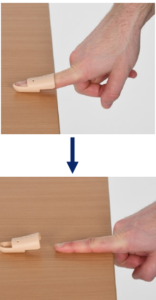
Two photographs showing the steps of removing a finger splint. In the top image, a hand with a finger splint rests on a table edge. In the bottom image, the splint has been removed, and the finger is fully extended and flat on the table surface, demonstrating the correct technique for removing the splint without bending the injured finger.

Treatment

A splint will be applied to keep the finger in a straight position at the end joint. The splint is worn continuously for 6 weeks followed by a further 2 weeks at night and for activities.

It is very important that the end joint does not bend during the splinted period.

When you remove the splint to wash your child’s finger, it must be held straight on a flat surface and not allowed to bend. You will be shown how to this.

Physiotherapy video

The vast majority of injuries treated by a splint will heal satisfactorily, leaving normal function.

Very occasionally, the tendon fails to heal; it can be treated by further splinting and possible surgical repair, although most fingers function well despite a droop at the end joint.

Mallet fractures may leave a small bump on the top of your finger and very rarely result in some loss of movement in the joint. Redness, tenderness and swelling are common for 3 to 4 months but will settle.

If you have any concerns about your child’s finger, please call 0131 312 0007 / 0131 312 0008 and ask for an appointment to be seen in the review clinic.

Possible Scaphoid Fracture

· Nov 5, 2024 ·

What is the scaphoid bone (skay-foyd)?

The scaphoid bone is a small bone on the thumb side of your wrist.

What causes a scaphoid fracture?

Most scaphoid fractures occur when you stretch your hand out in front of you to protect yourself from a fall. A fracture is the same as a break.

What are the symptoms?

Because most scaphoid fractures do not cause the wrist to look broken and many cause only minor symptoms, it can be hard to know if your scaphoid bone is broken. If the bone is broken, your child may have:

  • Pain, tenderness, or swelling on the thumb side of their wrist.
  • Difficulty gripping things or twisting their wrist or thumb.
  • Swelling around their wrist.

It can be hard to tell the difference between a wrist that is sprained and one that is broken: x-rays do not always show the fracture.

How is a scaphoid fracture diagnosed?

It is often difficult to diagnose a scaphoid fracture. Usually, an x-ray is requested but this may not show the fracture immediately.

If this is the case, your child will be given a wrist splint for support. You will also be given a phone number to use if your child is still having pain in the wrist after 2 weeks.

If your child is still having pain, call the number to book a clinic appointment. At the clinic, your child will be examined again, and will most likely have a repeat x-ray done to see if the fracture can now be seen on this x-ray.

There are times when we will also need to arrange another type of scan to be very sure there is a break in the bone. This is called an MRI scan and will be discussed at clinic if we think you need this.

What happens in the meantime?

The scaphoid bone has a poor blood supply and, as a result, it is important that a fracture is not missed. We will assume the bone is broken until we are certain it is not as this is the safest option for your child.

This involves placing the affected wrist in a splint. This should be worn most of the time, but can be taken off for 10 minutes a few times a day to let your child’s skin breathe.

The splint will help to reduce pain and your child can also use pain medication like Paracetamol or Ibuprofen.

What if it is broken?

Treatment for scaphoid fractures includes wearing a splint or plaster cast. In general terms, if the bone is broken then your child will require a plaster cast which they will need to wear for 6 weeks. Very rarely a bad fracture may need an operation. This will all be discussed with you and your child at clinics.

Physiotherapy video

Follow-up

To make a follow-up appointment please call
Paediatric Emergency Department Reception: – 0131 312 0017 or 0131 312 0018.

Trigger Thumb/Finger

· Nov 5, 2024 ·

What is a trigger thumb/finger?

Trigger thumb/finger (digit) is a condition which causes the affected digit to “lock” as it is bent towards the palm. It can be painful at the base of the digit when it is moved or has pressure applied to it. The digit can get stuck in the bent position and then suddenly “pop” straight.

What causes trigger thumb/finger?

Tendons connect bone to muscle and enable the joint to move as the muscle contracts. The tendon sits in a protective cover called the tendon sheath, which has a small amount of fluid within it to allow the tendon to move freely and smoothly.

A trigger thumb/finger is caused when there is a problem with the tendon or sheath, for example swelling and inflammation, which causes roughness on the tendon meaning it can’t slide easily.

The exact reason for this occurring isn’t fully known but it can occasionally start following an injury to the hand.

What are the symptoms of trigger thumb/finger?

A bent digit that appears to be ‘stuck’ in that position. There may also be a clicking of the digit on movement. Pain and tenderness may be experienced at the site of the triggering.

What are the treatment options?

Trigger thumb/finger is not harmful and often resolves itself without the need for any active treatment. It is advisable to try to avoid activities that cause pain during this time.

Surgery involves releasing the tendon sheath which allows the tendon to run freely through it.

This would be done by the Plastic Surgery team, and you will be referred to them for follow up.

We usually wait for the child to be between 3 and 4 years old before carrying out surgery.

Your doctor will discuss the options with you and advise the best course of treatment for your child.

What will the follow up be?

As trigger thumb/finger is often self-resolving it may just be followed up in the Plastic Surgery Outpatients’ Clinic.

If surgery is considered the best option for your child, this would be carried out as a day case procedure under general anaesthetic (asleep) and will be discussed with you during your clinic appointment.

What should I do if I’m worried?

Ask us for help. We are here to provide more information and advice. You can either contact the Paediatric Emergency Department – 0131 312 0017 / 0131 312 0018 or the Plastic Surgery Secretaries whose number you will find on your clinic letter.

Wrist/Hand sprain

· Oct 20, 2024 ·

What is a sprain?

Three diagrams showing hand anatomy. Three stages of the hand's anatomy: Left (Bones): The skeletal structure, including phalanges (fingers), metacarpals (palm), and carpals (wrist). Middle (Muscles & Tendons): Muscles and tendons responsible for movement, like flexor tendons for finger bending. Right (Skin): The outer layer, showing the hand’s surface.
A sprained hand or wrist is an injury that occurs when you fall or catch your hand, causing it to move or be pulled in an awkward way. This can stretch or damage the tough bands of tissue (ligaments) that help hold your bones together.

Ligaments help stabilise joints, preventing excessive movement. A sprain occurs when the ligaments are forced beyond their normal range of motion.

Treatment for a sprain depends on the severity of the injury but most recover well with a little time to recover and then simple rehab exercises once the pain has settled.

  • Page 1
  • Page 2
  • Go to Next Page »
NHS Lothian and EHCH logos
  • Facebook
  • Instagram
  • Twitter

More Information

  • About Us
  • Accessibility statement
  • Freedom of Information (FOI)
  • Disclaimer

Contact NHS Lothian

Main Switchboard: 0131 536 1000

  • About Us
Manage Cookie Consent
We use cookies to optimise our website and our service.
Functional Always active
The technical storage or access is strictly necessary for the legitimate purpose of enabling the use of a specific service explicitly requested by the subscriber or user, or for the sole purpose of carrying out the transmission of a communication over an electronic communications network.
Preferences
The technical storage or access is necessary for the legitimate purpose of storing preferences that are not requested by the subscriber or user.
Statistics
The technical storage or access that is used exclusively for statistical purposes. The technical storage or access that is used exclusively for anonymous statistical purposes. Without a subpoena, voluntary compliance on the part of your Internet Service Provider, or additional records from a third party, information stored or retrieved for this purpose alone cannot usually be used to identify you.
Marketing
The technical storage or access is required to create user profiles to send advertising, or to track the user on a website or across several websites for similar marketing purposes.
  • Manage options
  • Manage services
  • Manage {vendor_count} vendors
  • Read more about these purposes
Preferences
  • {title}
  • {title}
  • {title}