
Information for patients
Neck pain
What is neck pain?
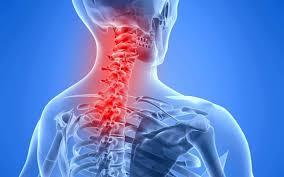
Neck pain can be caused by many different things, often in children and young people it is caused by growing bones and muscles becoming tight which can cause your neck and back to feel painful and sometimes stiff.
Very occasionally it can also be caused by the discs or bones of your spine but this isn’t very common in young people. In almost all cases of neck pain, it is completely safe and also very important to keep moving as best you can.
You may need to take things slowly initially or even take some pain relief but this shouldn’t be for a long period of time.
This leaflet contains some basic guidance on how to manage your neck pain. You may feel some stretching but shouldn’t feel any increase in your pain or sharp pain.
Neck and upper back anatomy
- Cervical Curve – the curve at the top of the spine in the neck region.
- Thoracic Curve – located in the upper to mid-back, this curve has a more pronounced outward curve.
- Lumbar Curve – found in the lower back, this curve curves inward.
- Intervertebral Discs – located between each vertebra, cushioning and separating them.
- Sacrum – located at the base of the spine, connecting the spine to the pelvis.
What is the best treatment?
The best thing you can do for most types of neck pain is to keep it gently moving and try your best not to worry about it too much. It is now known that worries can make neck pain feel worse so staying positive as well as following the following guidance should help reduce your pain. Other things that can help your neck feel better include:
- Simple pain relief
- Heat packs
- Gentle exercises
- Trying to avoid staying in one posture for long periods of time whilst playing on the computer or studying.
When should I seek further assessment or advice?
There are a few situations in which your child’s neck pain may require further investigation or assessment:
- If they have had a direct trauma/fall to their head or neck.
- If they are under 10 years old.
- If their neck pain goes on for more than two weeks without changing or improving.
- If they feel unwell and/or have a high temperature or unexplained weight loss.
- If their pain is getting progressively worse.
- If they have pain, pins and needles, numbness or weakness in their arms.
- If they start developing or complaining of stiffness or difficulty in moving.
- If they have difficulty breathing or swallowing.
- If they have a new onset of nausea or vomiting in the morning.
What if I need pain relief?
To manage your pain and keep your neck moving it is advised that you initially take regular simple pain relief. This can be bought over the counter from a pharmacist.
If you have any allergies or conditions which affect the use of pain relief or any questions or concerns please seek advice from your general practitioner (GP) or a pharmacist.
Rehabilitation and recovery
If you follow this advice leaflet your injury should take around 6-8 weeks for your pain to settle.
However, everyone recovers at different rates and it is dependent on the severity of the pain and discomfort, the soft tissue that was involved and the presence of any other medical problems.
Initial exercises
Try and start working through the following exercises as soon as you can – it is safe to start trying these exercises straight away.
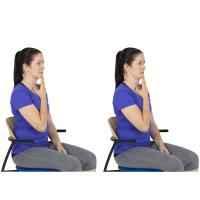
Exercise 1 ‘Chin Tuck’
- Sit up straight. S
- lightly tuck your chin in.
- You can assist the movement direction by slightly pressing your chin backwards with your fingers (hand supported on your chest).
Repeat 2-3 times a day.
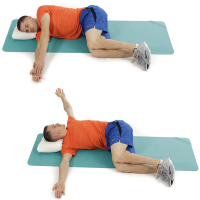
Exercise 2
- Lie on your side with your legs bent and your head supported with a towel. Arms straightened forwards.
- Keep your knees together. Breathe in, turn to look backwards and move your top arm towards the floor behind you.
- Breathe out and return to the starting position and repeat with the pace of your breathing.
Repeat 5-10 times on each side.
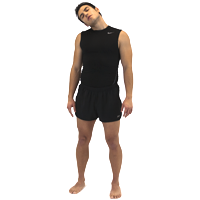
Exercise 3
- Sit or stand with your shoulders relaxed, and gently drop your ear down towards your shoulder until you can feel a stretch in the side of your neck.
- Hold for 30 seconds.
- Gently look down towards the floor so you can feel the stretch around the back of your neck as well.
Hold for a further 30 seconds and repeat 4-5 times a day.
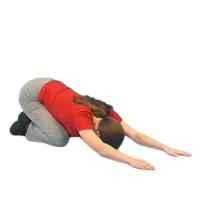
Exercise 4
- Kneel on the floor with your bottom on your heels, feet together and knees a little apart.
- Slide your hands away from you as if you a pushing your armpits down towards the floor.
Repeat 3-4 times a day.
Physiotherapy video
Exercises progressions
Start these exercises as soon as your movement has returned and your pain is starting to settle.
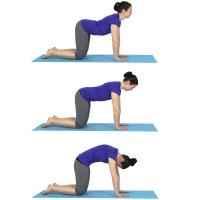
Exercise 1
- On all fours with your hips under your knees and hands under your shoulders.
- Look upwards whilst letting your back arch and your tummy lower towards the floor.
- Look downwards better your knees whilst arching your back upwards like a cat.
Repeat 5-10 times a day.
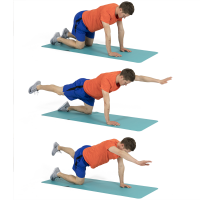
Exercise 2
- Take weight through your hands and knees whilst in four-point kneeling on the floor.
- Gently lift one arm and the opposite leg and stretch them outwards.
- Hold this position for 5-10 seconds returning to the start position.
- Repeat on alternate legs until you have completed 20 in total.
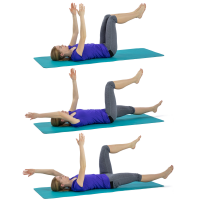
Exercise 3 ‘Dead bug’
- Lie on your back with your knees bent and arms up in the air.
- Slowly lower one arm and the opposite leg outwards whilst keeping the others still.
- Bring them back to the start position and then repeat with your other arm and leg.
Repeat 3×10 times a day.

Exercise 4
- Sit in a chair.
- Hold on to the side of the chair with one hand.
- Put the other hand over your head onto the opposite ear.
- Tilt your body and let the hand on the ear bend your head away from the side to be stretched.
- Hold for 30 seconds and repeat 2-3 times on each side.
Physiotherapy video
Return to sports and activity
Once your neck is no longer painful and the movement is much better you can gradually return to all normal activities if you have had to reduce some due to your pain.
As your neck continues to feel better you can gradually return to your usual activities like sports and physical education (PE) ensuring you warm up and cool down fully.
If you feel as though you are able to you do not have to wait for the go-ahead from a health professional to return to your normal activities.
Do I require further treatment?
If you have been able to return to all normal activities and your pain has settled well you likely don’t need any further treatment.
If you do have any concerns, ongoing pain or are struggling to return to your normal activities please call the physiotherapy department to speak with one of our physios and make a self-referral.
Physiotherapy Team
Therapies Department,
Royal Hospital for Children and Young People,
50 Little France Crescent
Edinburgh
EH16 4SA
Telephone: 0131 312 1079
