
Information for patients
Fractured clavicle (broken collar bone) Physiotherapy
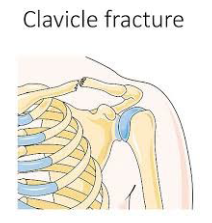
What is a fractured clavicle?
A broken collarbone or fractured clavicle is a common injury particularly in children and people playing contact sports. The collarbone is considered part of the shoulder and helps connect the arm to the body.
It lies above several important nerves and blood vessels, however, these structures are rarely involved when the collarbone breaks. The collarbone is a large bone, and the majority of the breaks occur in the centre section.
What is the best treatment?
Immediately after a collar bone fracture you will likely be given a sling to help support your arm. It is safe to remove the sling for washing and dressing or whilst watching TV etc.
Unless you have been advised otherwise by a Dr or physio it is very important to keep your shoulder gently moving as best as possible as well as trying to reduce the pain and swelling.
What if I need pain relief?
To manage your pain and keep your shoulder moving it is advised that you initially take regular simple pain relief.
This can be bought over the counter from a pharmacist. If you have any allergies or conditions which affect the use of pain relief or any questions or concerns please seek advice from your GP or a pharmacist.
Rehabilitation and Recovery
If you follow this advice leaflet your injury should take around 8-12 weeks to heal.
However, everyone recovers from injuries at different rates and it is dependent on the severity of the injury, the soft tissue that was involved and the presence of any other medical problems.
0 – 4 weeks since injury
If you have been given a sling in ED use this as required in the early stages. You should attempt to wean off it as soon as you feel able to and resume normal activities as soon as your shoulder feels comfortable and you feel able.
It is safe to move your arm in any way that feels comfortable and especially important to keep your neck, elbow, wrist and hand moving.
4 – 8 weeks since injury
Start to try and add in some gentle cardiovascular activity like walking as you feel able to as well as keeping other parts of your body moving like doing core stability exercises or lower body exercises if you feel able to.
You should try and gradually work through the exercises in this leaflet which will help you regain the movement in your shoulder and then gradually build up your strength.
6 – 12 weeks since injury
If you have followed all of the exercises within this guide and gradually built up your activity levels it is safe to start re-introducing more challenging activities such as gently returning to some sports activities and PE as you feel able to.
We recommend that you avoid any contact sports until 12 weeks after your injury.
Remember to always be guided by your shoulder – a little bit of pain that goes away quickly is normally nothing to worry about but if you are experiencing high levels of pain that don’t settle quickly or if your shoulder feels unstable in any way you should contact the physiotherapy department on 0131 3121079.
Initial exercises
Try and start working through the following exercises as soon as you can – it is safe to start trying these exercises right from the day after your injury.
Exercise 1
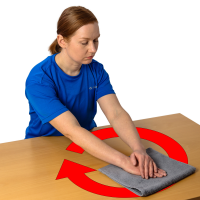
Exercise 1
- Sit with your hands on a table with your good hand on top of your injured hand and place something slidey under your hands.
- Move your hands around in as big a circles as you can manage so your shoulder moves forwards, backwards, out to the side and across your body.
- You may initially have to start with small movements but make them bigger as your arm feels more comfortable
Repeat 3×10 times, twice a day
Exercise 2
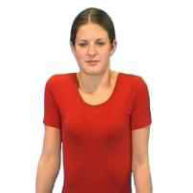
- When sitting or standing
- Shrug your shoulders up and down or backwards and forwards in circles.
Repeat regularly throughout the day as best you can.
Exercise 3

- Lie on your back with knees bent and feet flat on the floor, arms by your sides, palms downwards.
- Bend one elbow and bring the hand towards your shoulder with palm facing towards you. Return to the starting position. You can also do this exercise in standing.
- Try and move your wrist in all directions at the same time as well.
Repeat 3×10 a day.
Exercise 4
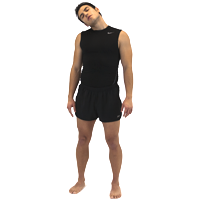
- Sometimes your neck can start to feel stiff if you are sore after breaking your collar bone.
- In standing or sitting move your head from side to side holding a stretch for approx. 30 seconds in each direction so you can feel a stretch down the side of your neck.
Repeat regularly throughout the day.
Exercise progressions
Start these exercises as soon as your movement has returned and your pain is starting to settle.
Exercise 1
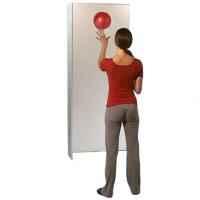
- Practice throwing and catching a ball with your injured arm, either against a wall or with a partner.
- Practice throwing at different heights and different speeds as well as over-arm and under-arm throws.
- Try and see how many times you can throw and catch without dropping the ball.
Exercise 2

- Kneel on your hands and knees with your weight evenly spread between all four limbs.
- Alternately lift one arm then the other arm up as far as you can. This will strengthen both arms so you should practice lifting both your injured and non injured arm.
- When this feels easy you can progress to lifting the opposite leg as well as your arm.
Repeat 3×10 times, twice a day.
Exercise 3

- Stand next to a wall.
- Place your hands on the wall, slightly wider than shoulder-width apart and fingers pointing upwards. Body is in a straight line.
- Keep body in a straight line and shoulders down.
- Bend your arms and lower your chest towards the wall. Straighten your arms and push back away from the wall.
Repeat 3×10 times a day.
Exercise 4
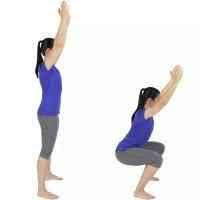
- Squats – it is important to keep your leg and back muscles strong whilst your arm recovers.
- Practice squatting but lifting your arms up above your head as you do so.
- If you have something you can hold between your hands as you lift them this is even better. You can use an exercise band, ball or broom handle.
Repeat 3×10 times a day.
Return to sports and activity
Once your shoulder is no longer painful and the movement is much better you can gradually return to gentle activities.
We normally advise that you rest from more vigorous and contact sports for 12 weeks following your injury.
If you feel as though you are able to, you do not have to wait for the go ahead from a health professional to return to your normal activities.
Do I require further treatment?
If you have regained full movement at your shoulder, elbow and wrist, are able to use your arm for all normal activities pain free and don’t have any feelings of discomfort you likely don’t need any further assessment or treatment.
If you do have any concerns, ongoing pain or are struggling to return to your normal activities please call the physiotherapy department to speak with one of our physios and make a self referral.
Physiotherapy Department
Royal Hospital for Children and Young People
50 Little France Crescent
Edinburgh
EH16 4SA
Telephone: 0131 312 1079
