• Skip to primary navigation
  • Skip to main content

Royal Hospital for Children and Young People

  • Home
    • Children
      • Coming to hospital
      • Being in hospital
      • Tests, Scans & X-rays
      • Having an operation
      • Going home
      • Wellbeing Hub
      • Health Resources
    • Young People
      • Coming to a clinic
      • Staying on a ward
      • Tests, Scans & X-rays
      • Going home
      • Transition to adult services
      • Wellbeing Hub
      • Health Resources
    • Parents and Carers
      • Accommodation for families
      • Financial Help & Advice
      • Charity support for children & families
      • Spiritual Care & The Sanctuary
      • Child Protection
      • Social Work
      • Play Service
      • Children with learning disabilities
      • Support and further information
      • Health Resources
  • Departments & Services
    • Community Services
    • Departments & Services
    • Health Resources
  • The RHCYP
    • Travel & Transport
    • Patient & Visitor Facilities
    • Wellbeing & further support
    • Radio Lollipop
    • Health Resources
  • Get Involved
    • About Us
    • ECH Charity
    • Family Council
    • Volunteer
    • Scottish Hospitals Inquiry
    • Radio Lollipop
  • Emergency Department
  • Show Search
  • Facebook
  • Twitter
Generic selectors
Exact matches only
Search in title
Search in content
Post Type Selectors
Search in posts
Search in pages
Filter by Categories
Accident and Emergency
Acorn Suite
Air Ambulance
Allergy
Anaesthetic
Asthma
Audiology
Bereavement Service
Blood Tests
Borthwick Ward
Brain
Breathing
Breathing support & Ventilation
CAMHS
Cardiology
Care Experienced Medical Team
Castle Mey Ward
Child Life & Health
Child Protection
Clinical Genetics
Clinical Research
Community Paediatrics
Community Services
Crichton Unit
Critical Care
Crohns
Cystic Fibrosis
Dalhousie Ward
Dental Service
Departments
Diabetes
Dietetics
Dirleton Ward
Discharge Planning Service
Dunvegan Ward
Ear Reconstruction
Emergency Department
Endocrinology
Epilepsy
Epilepsy Surgery
Gastroenterology (GI)
General Paediatrics
Haematology
Hepatology (Liver)
Hormones
IBD
Imaging Department (Scans & X-Rays)
Immunology and Infectious Diseases
Inflammatory Bowel Disease
Little France School
Lochranza
Major Trauma
Melville Unit
Neurodiversity
Neurosciences
Occupational Therapy
Oncology
Ophthalmology
Orthopaedics
Outpatients
Palliative Care
Pharmacy
Phlebotomy
Physiotherapy
Planned Investigations Unit
Plastic Dressings Clinic
Play
PPALS
Respiratory Department
Resuscitation Videos
Resuscitation Videos - British Sign Language (BSL)
Resuscitation Videos – Arabic
Resuscitation Videos – Bengali
Resuscitation Videos – Bulgarian
Resuscitation Videos – Cantonese
Resuscitation videos – English
Resuscitation Videos – Mandarin
Resuscitation Videos – Polish
Resuscitation Videos – Romanian
Resuscitation Videos – Spanish
Resuscitation Videos – Urdu
Rheumatology
Scans & X-Rays
Sleep
Social Work
Speech and Language Therapy
Spiritual Care
St John’s Hospital
Surgery
Trauma Service
Vision and Development
Hide Search

Neck

Tonsillitis in Children: A Guide for Parents

· Jun 18, 2025 ·

What is it?

Tonsillitis is an infection of the tonsils at the back of the throat. It is a common childhood illness and can be caused by viruses or bacteria. Tonsillitis can vary in severity and duration, ranging from mild discomfort to more severe symptoms that may require medical treatment.

What symptoms do you get?

Symptoms of tonsillitis in children may include:

  • Sore throat
  • Difficulty swallowing or pain with swallowing
  • Red and swollen tonsils
  • White or yellow patches or spots on the tonsils
  • Fever
  • Headache
  • Swollen lymph nodes in the neck
  • Bad breath
  • Hoarse voice or loss of voice

It’s essential to monitor your child’s symptoms closely and seek medical advice if they are experiencing severe symptoms or if their condition does not improve within a few days.

How is it diagnosed?

Diagnosing tonsillitis in children typically involves a physical examination by a healthcare professional. Your child’s healthcare provider will examine their throat and tonsils for signs of inflammation, redness, swelling, or pus. In some cases, a throat swab or culture may be taken to determine if the infection is caused by bacteria.

What is the treatment?

Treatment for tonsillitis in children depends on the underlying cause and severity of symptoms. In most cases, tonsillitis is caused by a virus, and antibiotics are not effective, so treatment is focused on relieving symptoms. This may include rest, plenty of fluids and over-the-counter pain relievers such as paracetamol or ibuprofen. Less commonly, the tonsillitis is caused by bacteria, and your child may require antibiotics to help clear the infection and prevent complications. It’s important to ensure your child completes the full course of antibiotics as prescribed, even if their symptoms improve before the medication is finished.

If you have any concerns about your child’s symptoms or if they are experiencing severe or persistent symptoms, seek medical advice promptly.
Congenital torticollis (Left side)

· Oct 21, 2024 ·

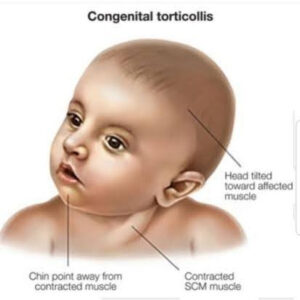
illustration labeled "Congenital Torticollis." It depicts a baby with a tilted head position, which is characteristic of this condition. The following features are marked: 1. Head tilted toward the affected muscle - The baby's head leans to one side, indicating the muscle contraction on that side. 2. Chin points away from contracted muscle - The baby's chin is turned away from the side with the contracted muscle. 3. Contracted SCM muscle - The Sternocleidomastoid (SCM) muscle on one side of the neck is shown as contracted, causing the tilt and turn of the head.
Congenital torticollis is a common condition affecting babies in their first few weeks. It presents as a tilting and rotation of the head and neck that is caused by tightness in the neck muscles. There may sometimes be a lump in the neck, which usually reaches maximum size within the first month and then gradually gets smaller.

Your baby’s head will tend to tilt towards the affected side, but they will look or turn away from it. The following positional techniques and stretches will help to correct this and stretch your baby’s muscles.

Congenital torticollis (Right side)

· Oct 21, 2024 ·

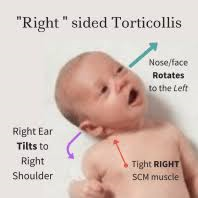
a baby with "right-sided torticollis," a condition where there is a noticeable tilt of the head. Specifically, the baby's right ear tilts toward the right shoulder, while the nose and face rotate to the left. This is due to tightness in the right sternocleidomastoid (SCM) muscle, which is marked in the image.
Congenital Torticollis is a common condition affecting babies in their first few weeks. It presents as a tilting and rotation of the head and neck that is caused by tightness in the neck muscles.

There may sometimes be a lump in the neck, which usually reaches maximum size within the first month and then gradually gets smaller.

Your baby’s head will tend to tilt towards the affected side, but they will look or turn away from it. The following positional techniques and stretches will help to correct this and stretch your baby’s muscles.

Neck pain

· Oct 20, 2024 ·

What is neck pain?


Neck pain can be caused by many different things, often in children and young people it is caused by growing bones and muscles becoming tight which can cause your neck and back to feel painful and sometimes stiff.

Very occasionally it can also be caused by the discs or bones of your spine but this isn’t very common in young people. In almost all cases of neck pain, it is completely safe and also very important to keep moving as best you can.

You may need to take things slowly initially or even take some pain relief but this shouldn’t be for a long period of time.

This leaflet contains some basic guidance on how to manage your neck pain. You may feel some stretching but shouldn’t feel any increase in your pain or sharp pain.

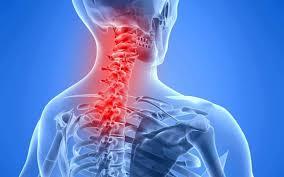
Neck and upper back anatomy

  • Cervical Curve –  the curve at the top of the spine in the neck region.
  • Thoracic Curve – located in the upper to mid-back, this curve has a more pronounced outward curve.
  • Lumbar Curve – found in the lower back, this curve curves inward.
  • Intervertebral Discs – located between each vertebra, cushioning and separating them.
  • Sacrum – located at the base of the spine, connecting the spine to the pelvis.

Acquired torticollis

· Oct 20, 2024 ·

Acquired torticollis most commonly occurs due to muscle spasms.

The muscle spasm tends to come on suddenly without any history of injury or any other symptoms such as sore throat or temperature.

There will be pain on the side of the tight muscles and the head might feel stuck or too painful to move.

If your child has suffered an injury before the muscle spasm, they should be seen in the Emergency Department.

Management

Give good amounts of pain relief regularly for the first 24-48 hours and then as required.

  • Paracetamol and Ibuprofen – dose as per the recommendation on the bottle/packet.
  • Paracetamol and Ibuprofen are even better at treating pain if you give them at the same time.
  • Give every 6 hours in the first few days.

It can be useful to put a hot or cold pack over the painful area to reduce pain and spasms.

Encourage gentle exercises frequently:

  1. Look up, look down
  2. Look side to side
  3. Stretch the ear towards the shoulder
  4. Bring the chin to the chest, and stick the chin out.

The gentle movement of the neck is important to stop the muscles stiffening up.

Things should be much improved within a couple of days. If things are not improving or there is an ongoing concern, you should speak firstly to your GP.

Things to look out for when your child has a sore neck:

  • Any fever
  • Pain or swelling on touching the neck
  • Drooling or difficulty swallowing
  • Change in voice.
NHS Lothian and EHCH logos
  • Facebook
  • Instagram
  • Twitter

More Information

  • About Us
  • Accessibility statement
  • Freedom of Information (FOI)
  • Disclaimer

Contact NHS Lothian

Main Switchboard: 0131 536 1000

  • About Us
Manage Cookie Consent
We use cookies to optimise our website and our service.
Functional Always active
The technical storage or access is strictly necessary for the legitimate purpose of enabling the use of a specific service explicitly requested by the subscriber or user, or for the sole purpose of carrying out the transmission of a communication over an electronic communications network.
Preferences
The technical storage or access is necessary for the legitimate purpose of storing preferences that are not requested by the subscriber or user.
Statistics
The technical storage or access that is used exclusively for statistical purposes. The technical storage or access that is used exclusively for anonymous statistical purposes. Without a subpoena, voluntary compliance on the part of your Internet Service Provider, or additional records from a third party, information stored or retrieved for this purpose alone cannot usually be used to identify you.
Marketing
The technical storage or access is required to create user profiles to send advertising, or to track the user on a website or across several websites for similar marketing purposes.
  • Manage options
  • Manage services
  • Manage {vendor_count} vendors
  • Read more about these purposes
Preferences
  • {title}
  • {title}
  • {title}