• Skip to primary navigation
  • Skip to main content

Royal Hospital for Children and Young People

  • Home
    • Children
      • Coming to hospital
      • Being in hospital
      • Tests, Scans & X-rays
      • Having an operation
      • Going home
      • Wellbeing Hub
      • Health Resources
    • Young People
      • Coming to a clinic
      • Staying on a ward
      • Tests, Scans & X-rays
      • Going home
      • Transition to adult services
      • Wellbeing Hub
      • Health Resources
    • Parents and Carers
      • Accommodation for families
      • Financial Help & Advice
      • Charity support for children & families
      • Spiritual Care & The Sanctuary
      • Child Protection
      • Social Work
      • Play Service
      • Children with learning disabilities
      • Support and further information
      • Health Resources
  • Departments & Services
    • Community Services
    • Departments & Services
    • Health Resources
  • The RHCYP
    • Travel & Transport
    • Patient & Visitor Facilities
    • Wellbeing & further support
    • Radio Lollipop
    • Health Resources
  • Get Involved
    • About Us
    • ECH Charity
    • Family Council
    • Volunteer
    • Scottish Hospitals Inquiry
    • Radio Lollipop
  • Emergency Department
  • Show Search
  • Facebook
  • Twitter
Generic selectors
Exact matches only
Search in title
Search in content
Post Type Selectors
Search in posts
Search in pages
Filter by Categories
Accident and Emergency
Acorn Suite
Air Ambulance
Allergy
Anaesthetic
Asthma
Audiology
Bereavement Service
Blood Tests
Borthwick Ward
Brain
Breathing
Breathing support & Ventilation
CAMHS
Cardiology
Care Experienced Medical Team
Castle Mey Ward
Child Life & Health
Child Protection
Clinical Genetics
Clinical Research
Community Paediatrics
Community Services
Crichton Unit
Critical Care
Crohns
Cystic Fibrosis
Dalhousie Ward
Dental Service
Departments
Diabetes
Dietetics
Dirleton Ward
Discharge Planning Service
Dunvegan Ward
Ear Reconstruction
Emergency Department
Endocrinology
Epilepsy
Epilepsy Surgery
Gastroenterology (GI)
General Paediatrics
Haematology
Hepatology (Liver)
Hormones
IBD
Imaging Department (Scans & X-Rays)
Immunology and Infectious Diseases
Inflammatory Bowel Disease
Little France School
Lochranza
Major Trauma
Melville Unit
Neurodiversity
Neurosciences
Occupational Therapy
Oncology
Ophthalmology
Orthopaedics
Outpatients
Palliative Care
Pharmacy
Phlebotomy
Physiotherapy
Planned Investigations Unit
Plastic Dressings Clinic
Play
PPALS
Respiratory Department
Resuscitation Videos
Resuscitation Videos - British Sign Language (BSL)
Resuscitation Videos – Arabic
Resuscitation Videos – Bengali
Resuscitation Videos – Bulgarian
Resuscitation Videos – Cantonese
Resuscitation videos – English
Resuscitation Videos – Mandarin
Resuscitation Videos – Polish
Resuscitation Videos – Romanian
Resuscitation Videos – Spanish
Resuscitation Videos – Urdu
Rheumatology
Scans & X-Rays
Sleep
Social Work
Speech and Language Therapy
Spiritual Care
St John’s Hospital
Surgery
Trauma Service
Vision and Development
Hide Search

Foot and ankle

Henoch-Schönlein Purpura (HSP), or IgA Vasculitis, in Children: A Guide for Parents

· Jun 18, 2025 ·

Henoch-Schönlein Purpura (HSP), now known as IgA vasculitis, is a type of inflammatory condition known as vasculitis, that affects the small blood vessels in the skin, joints, intestines, and kidneys. It is one of the most common types of vasculitis in children and typically occurs between the ages of 2 and 11 years old. While the exact cause of HSP is unknown, it is believed to be related to an abnormal immune system response, often triggered by a preceding infection.

What symptoms do you get?

Symptoms of HSP can vary but often include:

  • Purpura: Small, raised purple or red spots on the skin, typically on the legs and buttocks, which may be painful or itchy.
  • Joint pain and swelling, particularly in the knees and ankles.
  • Abdominal pain or cramping.
  • Nausea, vomiting, or bloody stools.
  • Kidney involvement, which may lead to blood or protein in the urine, decreased urine output, or high blood pressure.

It’s essential to seek medical advice if your child develops any of these symptoms, especially if they occur suddenly or worsen over time.

How is it diagnosed?

Diagnosing HSP in children usually involves a combination of a physical examination, medical history, and blood and urine tests. Blood tests are done to check for signs of inflammation and to assess kidney function, while urine is tested for blood and protein. Your child’s blood pressure will also be taken.

What is the treatment?

In most cases, HSP resolves on its own within a few weeks to months without specific treatment. However, symptomatic relief may be provided with over-the-counter pain relievers such as paracetamol to alleviate joint pain and discomfort. It’s essential to follow your healthcare provider’s advice closely and attend regular follow-up appointments to monitor your child’s progress as about half of children with HSP will have a further episode. Typically, your child will be followed up at regular intervals for one year.

Rarely, in more severe cases your child may require additional treatments such as medicines to reduce inflammation and protect organ function.

Most cases of HSP will be monitored and resolve without long-term complications. If you have any concerns about your child’s health or if their symptoms are severe or worsening, seek medical advice promptly.
Minor Injuries of the Foot

· Dec 18, 2024 ·

What is a metatarsal fracture?

The metatarsals are the bones in the foot that attach the toes to the ankle. A fracture is the same as a cracked or broken bone. This will be seen on an x-ray. These are minor injuries that will make a full recovery.

What to expect

  • Your child will have some pain. It should be mild and settle over the next few days, but it may take 2 – 6 weeks for the pain to fully disappear.
  • There may be bruising and swelling which is normal and should improve during the first week.
  • It can take 4 – 6 weeks before the bone has fully healed. If you were given a supportive boot, you can stop using this after 2 weeks when there is little pain on walking. You should then wear a cushioned, supportive shoe.

Treatment

  • These injuries heal well with time. They do not need a cast or need to visit a bone specialist. Your child may be given a rigid boot or shoe that can support the injured foot while it is healing, or a well-cushioned supportive shoe does the same job.
  • Gentle movement and body weight can be taken while wearing the boot. This works better than keeping it completely still. Moving the foot gently, even if it causes a little discomfort, will not cause more damage.
  • Keep the foot up on a pillow when sitting. This will reduce swelling.
  • Improve movement by flexing the ankle up and down. Try tracing circles with the big toe in the air.
  • Use paracetamol or Ibuprofen as a painkiller. Please always give medication as indicated on the label.

Returning to sport

  • Return to ‘no-impact’ sport like swimming gradually once the pain has improved, usually 2 – 4 weeks.
  • Once your child is pain-free and able to run without causing the pain to return, they can return to their normal activities. This is usually around 4 weeks.

If your child’s pain is not improving or they are still experiencing high levels of pain after 4 weeks, please contact the Emergency Department on 0131 312 0007 / 0131 312 0008 and ask for a face-to-face review clinic appointment.

Plantar fasciopathy

· Nov 7, 2024 ·

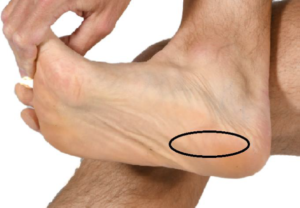
Image of a foot being held by the big toe with the heel part of the foot circled in black

What is plantar fasciopathy?

Plantar fasciopathy is when there are inflammatory or structural changes to the plantar fascia ligament in your heel resulting in pain. This is also described as plantar heel pain.

What are the causes?

There are several proposed risk factors for plantar fasciopathy including:

  • Weight-bearing activity (e.g. standing)
  • Tight calf muscles
  • Obesity
  • Foot shape and/or the way your foot moves
  • Existing medical conditions (e.g. Diabetes)

What are the symptoms?

  • Pain in the affected heel which may extend into the arch of your foot
  • Pain made worse by weight-bearing activity (e.g. standing)
  • Intense pain during your first few steps after a period of inactivity (particularly in the morning when getting out of bed)
  • Tenderness over your heel

How is it diagnosed?

An appropriate healthcare professional will discuss your symptoms and enquire about your general health. A physical examination of your foot and ankle will be carried out to assess your movement, response to particular tests and level of pain. This condition is diagnosed by clinical examination. In rare cases diagnostic imaging may be required.

Toddler’s fracture

· Oct 21, 2024 ·

A Toddler’s fracture is a small break, often referred to as a ‘hair-line fracture’, to the shin bone (tibia), the large bone in the lower part of the leg. This type of injury is typically caused by a minor fall or a simple twisting of the leg and is very common in children under 3 years of age.

Hearing us say your child has a ‘fracture’ sounds serious. The good news is, that your child has a minor injury – the bones are stable and held in the right place, no procedures are needed, and your child will make a full recovery.

illustration of a child's bone showing a thin crack on the bone (toddler's fracture)

What tests will be done?

Your child may have an x-ray. The nurse practitioner or doctor will make this decision based on the history of the injury, their examination, and the age of your child. Toddler’s fractures don’t always show up on the first x-ray because they are so small.

What is the treatment?

The nurse practitioner or doctor will discuss a treatment plan with you as it is not always necessary to immobilise the leg with a plaster cast or moonboot. Your child may only require simple painkillers such as Paracetamol (calpol) and Ibuprofen, and rest.

What should we do when we get home?

We recommend that you give your child regular paracetamol (calpol) and/or ibuprofen for the first 48 hours. Your child will adapt to having sore leg and will change their play for this. This means they may go back to crawling or may just want to be carried. If they want to walk that is absolutely fine.

If you feel that your child is too sore despite having regular painkillers, please bring them to the Emergency Department so we can review them.

Follow-up

It may be several weeks before your child walks normally again. They often walk with a limp, or their foot turned out initially but this will improve.

If your child is not walking normally 4 weeks after the injury, please contact the Emergency Department on 0131 312 0007 or 0131 312 0008 and ask for a face-to-face review clinic appointment.

Sever’s Disease

· Oct 21, 2024 ·

What Is Sever’s Disease?

Sever’s Disease is a common cause of foot and heel pain in children and adolescents. It is not yet known exactly what causes Sever’s but it is thought to be caused by repeated stress around where your calf muscles attach to the heel bone.

This can cause a traction-type injury where the local bone and soft tissues can become inflamed and sore, especially during certain foot and ankle movements and activities.

Pain is most commonly felt around the back of your heel, sometimes up into your calf a little and also sometimes down into the sole of your foot.

Who can get Sever’s?

  • Children and adolescents going through a large growth spurt.
  • Children aged 8-15 with a greater incidence in boys.
  • Children and adolescents who participate in repeated high-intensity activity with higher impact such as hopping, jumping and change of direction.
  • Higher incidence in athletes who specialise in only one sport early.

What are the most common symptoms?

  • Heel pain either during or after participation in sports which typically eases with rest.
  • Tenderness around your heel bone.
  • Reduced calf strength.
  • Tightness of your leg muscles.

These symptoms usually come on gradually and can appear in one or both of your feet.

  • Page 1
  • Page 2
  • Go to Next Page »
NHS Lothian and EHCH logos
  • Facebook
  • Instagram
  • Twitter

More Information

  • About Us
  • Accessibility statement
  • Freedom of Information (FOI)
  • Disclaimer

Contact NHS Lothian

Main Switchboard: 0131 536 1000

  • About Us
Manage Cookie Consent
We use cookies to optimise our website and our service.
Functional Always active
The technical storage or access is strictly necessary for the legitimate purpose of enabling the use of a specific service explicitly requested by the subscriber or user, or for the sole purpose of carrying out the transmission of a communication over an electronic communications network.
Preferences
The technical storage or access is necessary for the legitimate purpose of storing preferences that are not requested by the subscriber or user.
Statistics
The technical storage or access that is used exclusively for statistical purposes. The technical storage or access that is used exclusively for anonymous statistical purposes. Without a subpoena, voluntary compliance on the part of your Internet Service Provider, or additional records from a third party, information stored or retrieved for this purpose alone cannot usually be used to identify you.
Marketing
The technical storage or access is required to create user profiles to send advertising, or to track the user on a website or across several websites for similar marketing purposes.
  • Manage options
  • Manage services
  • Manage {vendor_count} vendors
  • Read more about these purposes
Preferences
  • {title}
  • {title}
  • {title}