• Skip to primary navigation
  • Skip to main content

Royal Hospital for Children and Young People

  • Home
    • Children
      • Coming to hospital
      • Being in hospital
      • Tests, Scans & X-rays
      • Having an operation
      • Going home
      • Wellbeing Hub
      • Health Resources
    • Young People
      • Coming to a clinic
      • Staying on a ward
      • Tests, Scans & X-rays
      • Going home
      • Transition to adult services
      • Wellbeing Hub
      • Health Resources
    • Parents and Carers
      • Accommodation for families
      • Financial Help & Advice
      • Charity support for children & families
      • Spiritual Care & The Sanctuary
      • Child Protection
      • Social Work
      • Play Service
      • Children with learning disabilities
      • Support and further information
      • Health Resources
  • Departments & Services
    • Community Services
    • Departments & Services
    • Health Resources
  • The RHCYP
    • Travel & Transport
    • Patient & Visitor Facilities
    • Wellbeing & further support
    • Radio Lollipop
    • Health Resources
  • Get Involved
    • About Us
    • ECH Charity
    • Family Council
    • Volunteer
    • Scottish Hospitals Inquiry
    • Radio Lollipop
  • Emergency Department
  • Show Search
  • Facebook
  • Twitter
Generic selectors
Exact matches only
Search in title
Search in content
Post Type Selectors
Search in posts
Search in pages
Filter by Categories
Accident and Emergency
Acorn Suite
Air Ambulance
Allergy
Anaesthetic
Asthma
Audiology
Bereavement Service
Blood Tests
Borthwick Ward
Brain
Breathing
Breathing support & Ventilation
CAMHS
Cardiology
Care Experienced Medical Team
Castle Mey Ward
Child Life & Health
Child Protection
Clinical Genetics
Clinical Research
Community Paediatrics
Community Services
Crichton Unit
Critical Care
Crohns
Cystic Fibrosis
Dalhousie Ward
Dental Service
Departments
Diabetes
Dietetics
Dirleton Ward
Discharge Planning Service
Dunvegan Ward
Ear Reconstruction
Emergency Department
Endocrinology
Epilepsy
Epilepsy Surgery
Gastroenterology (GI)
General Paediatrics
Haematology
Hepatology (Liver)
Hormones
IBD
Imaging Department (Scans & X-Rays)
Immunology and Infectious Diseases
Inflammatory Bowel Disease
Little France School
Lochranza
Major Trauma
Melville Unit
Neurodiversity
Neurosciences
Occupational Therapy
Oncology
Ophthalmology
Orthopaedics
Outpatients
Palliative Care
Pharmacy
Phlebotomy
Physiotherapy
Planned Investigations Unit
Plastic Dressings Clinic
Play
PPALS
Respiratory Department
Resuscitation Videos
Resuscitation Videos - British Sign Language (BSL)
Resuscitation Videos – Arabic
Resuscitation Videos – Bengali
Resuscitation Videos – Bulgarian
Resuscitation Videos – Cantonese
Resuscitation videos – English
Resuscitation Videos – Mandarin
Resuscitation Videos – Polish
Resuscitation Videos – Romanian
Resuscitation Videos – Spanish
Resuscitation Videos – Urdu
Rheumatology
Scans & X-Rays
Sleep
Social Work
Speech and Language Therapy
Spiritual Care
St John’s Hospital
Surgery
Trauma Service
Vision and Development
Hide Search

Snapping ‘clicky’ hip

Snapping ‘clicky’ hip

· Oct 20, 2024 ·

What is it?

People who pop, click, or snap their hips during particular movements have snapping hip syndrome. Some people make an audible click when they bend at the hip.

For other people, they may feel a popping or catching in their hip joint.

There are two types of snapping hip and while they are mostly harmless, these conditions sometimes lead to joint pain.

Types of snapping hip

Illustration of the front of the hip joint with joints, muscles and bones. It has a red-highlighted muscle, showing a tendon sliding over bones at the front of the hip joint, creating tension and then releasing with a “snap.

Internal snapping hip (at the front of the hip)

This type of snapping hip is the most common. It occurs when a tendon slides over bony structures at the front of the hip joint, creating tension and then releasing with a “snap.”

Tightness in the muscles around your bottom or hip is often the cause of the snapping sound.

People with internal snapping hip syndrome may experience:

  • Hip popping is when: running, rising from a seated position or when the hip turns the leg away from the body.
  • Pain that worsens with activity as repeated irritation is associated with inflammation of the structures at the front of the hip joint.

Illustration of a human hip with a highlighted hip flexor muscle and pain indicator.

External snapping hip (at the side of the hip)

This occurs when a muscle or tendon slides over the top of the thigh bone. The resulting tension is followed by a release and snapping sensation at the outside of the hip. This is often due to tightness in the muscles around your bottom.

People with external snapping hip syndrome may experience:

  • The snapping typically occurs during activities such as running and climbing stairs or carrying a heavy load like shopping or a heavy backpack.
  • Hip popping can be accompanied by sharp, sudden pain felt on the outside of the hip.
  • The hip can sometimes feel like it is about to pop out of its socket when snapping but it will not come out of its socket.
  • Pain that worsens with activity, as repeated irritation causes the tendon to become inflamed.

Painful symptoms develop gradually; the pain may begin as a mild annoyance and worsen over weeks or months.

Treatment

  • Rest: People with snapping hip syndrome are advised to avoid the motions or activities that cause the snapping, popping or clicking sensation as much as possible. Resting helps to reduce any irritation around the hip.
  • Stretching: Often muscles surrounding the hip joint are tight and increasing their flexibility it can reduce pain and the amount of ‘snapping’ of the hip.

Daily stretching programme

Exercise 1

  • Put one leg out behind you whilst half kneeling on the other.
  • Keep your back straight and lean forward into your bent leg and feel the stretch over the front of your thigh on the leg behind.
  • Hold for 30 seconds.

Repeat 3 times on both legs, daily.
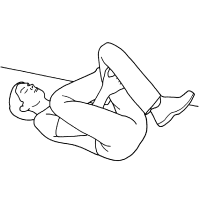
Exercise 2

  • Lie on your back with your knees bent.
  • Cross the ankle of the leg to be stretched over the other knee.
  • Put your arms around your thigh.
  • Bring your thigh towards your stomach. Feel the stretch in your bottom muscles.
  • Hold for 30 seconds.

Repeat 3 times on both legs, daily.

Exercise 3

  • Lie face down.
  • Bend your knee and hold on to your ankle. Pull your heel towards your bottom. Feel the stretching on the front of your thigh.
  • Hold for 30 seconds.

Repeat 3 times on both legs, daily.
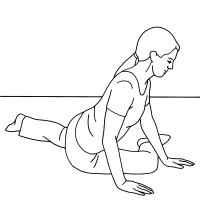
Exercise 4

  • Sit on the floor.
  • Bring one leg in front of you and bend your knee 45 degrees.
  • Straighten your other leg behind you.
  • Turn your body towards the bent leg and lean your body gently forward. Feel the stretch in your bottom muscles.
  • Hold for 30 seconds.

Repeat 3 times on both legs, daily.

Physiotherapy video

Return to activity

Once your pain has improved or the ‘snapping’ sensation has reduced then you can gradually return to your usual activities. Ensure you warm up and cool down properly. Your pain should be used as a guide as to when to increase the length or amount of activity.

Further advice

If your symptoms are not settling, please contact the physiotherapy department on the details below:

NHS Lothian and EHCH logos
  • Facebook
  • Instagram
  • Twitter

More Information

  • About Us
  • Accessibility statement
  • Freedom of Information (FOI)
  • Disclaimer

Contact NHS Lothian

Main Switchboard: 0131 536 1000

  • About Us
Manage Cookie Consent
We use cookies to optimise our website and our service.
Functional Always active
The technical storage or access is strictly necessary for the legitimate purpose of enabling the use of a specific service explicitly requested by the subscriber or user, or for the sole purpose of carrying out the transmission of a communication over an electronic communications network.
Preferences
The technical storage or access is necessary for the legitimate purpose of storing preferences that are not requested by the subscriber or user.
Statistics
The technical storage or access that is used exclusively for statistical purposes. The technical storage or access that is used exclusively for anonymous statistical purposes. Without a subpoena, voluntary compliance on the part of your Internet Service Provider, or additional records from a third party, information stored or retrieved for this purpose alone cannot usually be used to identify you.
Marketing
The technical storage or access is required to create user profiles to send advertising, or to track the user on a website or across several websites for similar marketing purposes.
  • Manage options
  • Manage services
  • Manage {vendor_count} vendors
  • Read more about these purposes
Preferences
  • {title}
  • {title}
  • {title}