• Skip to primary navigation
  • Skip to main content

Royal Hospital for Children and Young People

  • Home
    • Children
      • Coming to hospital
      • Being in hospital
      • Tests, Scans & X-rays
      • Having an operation
      • Going home
      • Wellbeing Hub
      • Health Resources
    • Young People
      • Coming to a clinic
      • Staying on a ward
      • Tests, Scans & X-rays
      • Going home
      • Transition to adult services
      • Wellbeing Hub
      • Health Resources
    • Parents and Carers
      • Accommodation for families
      • Financial Help & Advice
      • Charity support for children & families
      • Spiritual Care & The Sanctuary
      • Child Protection
      • Social Work
      • Play Service
      • Children with learning disabilities
      • Support and further information
      • Health Resources
  • Departments & Services
    • Community Services
    • Departments & Services
    • Health Resources
  • The RHCYP
    • Travel & Transport
    • Patient & Visitor Facilities
    • Wellbeing & further support
    • Radio Lollipop
    • Health Resources
  • Get Involved
    • About Us
    • ECH Charity
    • Family Council
    • Volunteer
    • Scottish Hospitals Inquiry
    • Radio Lollipop
  • Emergency Department
  • Show Search
  • Facebook
  • Twitter
Generic selectors
Exact matches only
Search in title
Search in content
Post Type Selectors
Search in posts
Search in pages
Filter by Categories
Accident and Emergency
Acorn Suite
Air Ambulance
Allergy
Anaesthetic
Asthma
Audiology
Bereavement Service
Blood Tests
Borthwick Ward
Brain
Breathing
Breathing support & Ventilation
CAMHS
Cardiology
Care Experienced Medical Team
Castle Mey Ward
Child Life & Health
Child Protection
Clinical Genetics
Clinical Research
Community Paediatrics
Community Services
Crichton Unit
Critical Care
Crohns
Cystic Fibrosis
Dalhousie Ward
Dental Service
Departments
Diabetes
Dietetics
Dirleton Ward
Discharge Planning Service
Dunvegan Ward
Ear Reconstruction
Emergency Department
Endocrinology
Epilepsy
Epilepsy Surgery
Gastroenterology (GI)
General Paediatrics
Haematology
Hepatology (Liver)
Hormones
IBD
Imaging Department (Scans & X-Rays)
Immunology and Infectious Diseases
Inflammatory Bowel Disease
Little France School
Lochranza
Major Trauma
Melville Unit
Neurodiversity
Neurosciences
Occupational Therapy
Oncology
Ophthalmology
Orthopaedics
Outpatients
Palliative Care
Pharmacy
Phlebotomy
Physiotherapy
Planned Investigations Unit
Plastic Dressings Clinic
Play
PPALS
Respiratory Department
Resuscitation Videos
Resuscitation Videos - British Sign Language (BSL)
Resuscitation Videos – Arabic
Resuscitation Videos – Bengali
Resuscitation Videos – Bulgarian
Resuscitation Videos – Cantonese
Resuscitation videos – English
Resuscitation Videos – Mandarin
Resuscitation Videos – Polish
Resuscitation Videos – Romanian
Resuscitation Videos – Spanish
Resuscitation Videos – Urdu
Rheumatology
Scans & X-Rays
Sleep
Social Work
Speech and Language Therapy
Spiritual Care
St John’s Hospital
Surgery
Trauma Service
Vision and Development
Hide Search

Asthma

Preschool Viral Wheeze: A Guide for Parents

· Jun 18, 2025 ·

Preschool viral wheeze is common. A virus causes swelling, and mucus clogs the airways. It causes difficulty breathing and cough. It looks like asthma, however only happens once or twice in most children before they reach school age. About 1 in every 3 children with preschool wheeze will develop asthma later in life.

What symptoms do you get?

Wheeze is a high-pitched whistling sound that occurs when your child breathes out. Other symptoms may include coughing, chest tightness, and difficulty breathing.

How is it diagnosed?

Preschool viral wheeze is typically diagnosed based on your child’s symptoms and a physical examination by a healthcare professional. Sometimes other tests are done if the wheeze is very severe.

What is the treatment?

The main treatment is inhaled Salbutamol. This medicine is breathed in through an inhaler regularly until the symptoms get better. Salbutamol works quickly, for a short time. Often another medicine is given by mouth which is a steroid called Prednisolone. Prednisolone works slowly, but lasts a long time. If your child is very unwell other treatments are given and your child may be kept in hospital until things improve. When it’s time to go home, you will be given a wheeze plan to follow at home.
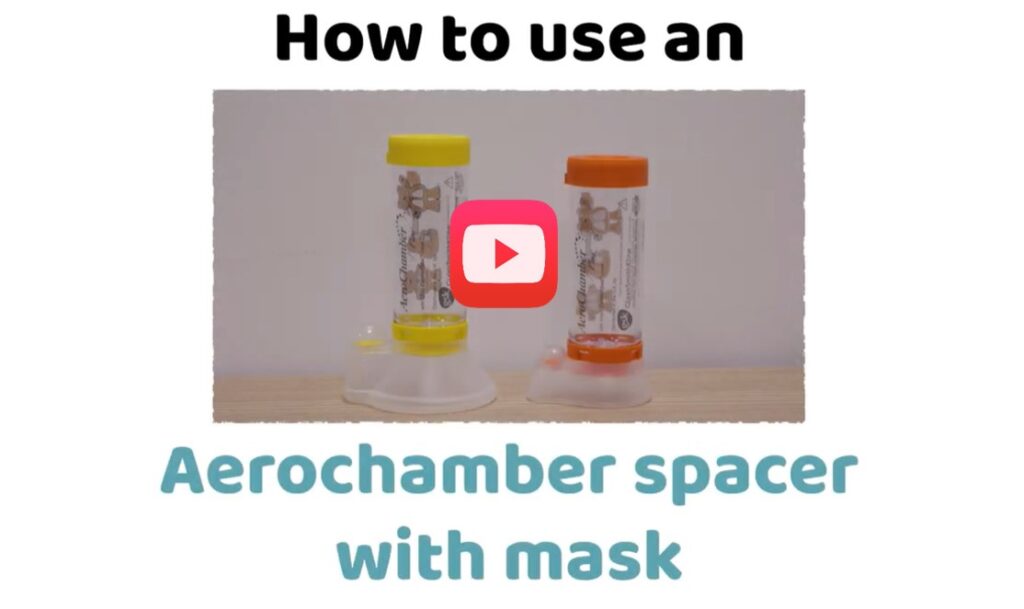
Video on how to use an aerochamber spacer with mask video

Click on the image above to watch how to use an aerochamber spacer with a mask.

Remember, preschool viral wheeze should get better after a few days. If you are worried about your child you should get help quickly.

Eczema

· Jun 18, 2025 ·

What is eczema?

Eczema is a common skin condition which usually first presents in childhood, affecting 1 in 5 children in the UK. It often runs in families and can be associated with other allergic-type conditions (also known as atopic conditions) such as hayfever, food allergies and asthma. Eczema can be variable from person to person, affecting different parts of the body and with different levels of impact on the individual.

What causes eczema?

Your skin is a natural barrier which protects you from the outside world whilst also keeping the moisture in. In eczema, the barrier doesn’t work as well as it should, allowing moisture to seep out and things from the environment to get in. This results in skin which is dry, inflamed and itchy due to a loss of moisture and irritation from particles in the environment.

Click here to watch a video on what eczema is and its symptoms

The skin in eczema is usually itchy and dry, and if severe can cause difficulties with sleeping and participating in regular activities. Sometimes the skin will bleed due to scratching, and over time the skin can become thickened due to repeated scratching.

Often these symptoms fluctuate, with episodes called ‘flares’; sometimes flares occur due to exposure to a trigger, at other times there is no clear cause.

Eczema can affect anywhere on the body, but typically is found in the joint creases in children, for example the knees and elbows. In babies it often begins on the cheeks.


NHS Lothian and EHCH logos
  • Facebook
  • Instagram
  • Twitter

More Information

  • About Us
  • Accessibility statement
  • Freedom of Information (FOI)
  • Disclaimer

Contact NHS Lothian

Main Switchboard: 0131 536 1000

  • About Us
Manage Cookie Consent
We use cookies to optimise our website and our service.
Functional Always active
The technical storage or access is strictly necessary for the legitimate purpose of enabling the use of a specific service explicitly requested by the subscriber or user, or for the sole purpose of carrying out the transmission of a communication over an electronic communications network.
Preferences
The technical storage or access is necessary for the legitimate purpose of storing preferences that are not requested by the subscriber or user.
Statistics
The technical storage or access that is used exclusively for statistical purposes. The technical storage or access that is used exclusively for anonymous statistical purposes. Without a subpoena, voluntary compliance on the part of your Internet Service Provider, or additional records from a third party, information stored or retrieved for this purpose alone cannot usually be used to identify you.
Marketing
The technical storage or access is required to create user profiles to send advertising, or to track the user on a website or across several websites for similar marketing purposes.
  • Manage options
  • Manage services
  • Manage {vendor_count} vendors
  • Read more about these purposes
Preferences
  • {title}
  • {title}
  • {title}